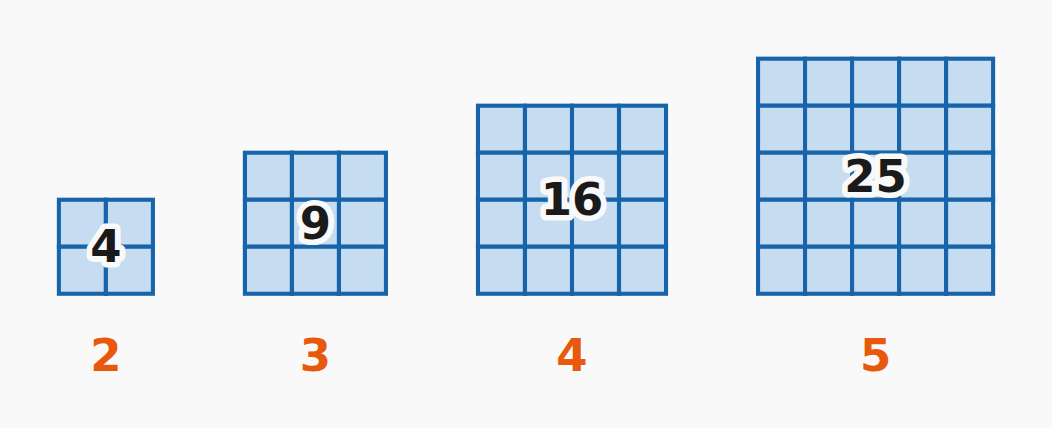
A perfect square is a whole number you get by multiplying a whole number by itself. So 1, 4, 9, 16, 25, 36 … are perfect squares, because 1 = 1·1, 4 = 2·2, 9 = 3·3, and so on.
Squaring and its opposite
Squaring a number means multiplying it by itself: 7² = 7·7 = 49. The square root does the opposite — it asks "which number, multiplied by itself, gives this?" So √49 = 7, because 7·7 = 49.
Because squaring and taking the square root undo each other, it pays to know the squares up to about 15·15 = 225 by heart. Then √81 = 9 and √144 = 12 come instantly.
A worked example
To find √121, ask: which number times itself is 121? Try 10 → 100 (too small), 11 → 121. So √121 = 11.
Three rules that always help
- A perfect square is a whole number times itself; its square root is a whole number.
- The square root undoes squaring, so √(n²) = n.
- If you know your squares to 15², most grade-8 square roots are instant recall.
Keep going
- Practice: Square root of a perfect square
- Back to the square roots overview