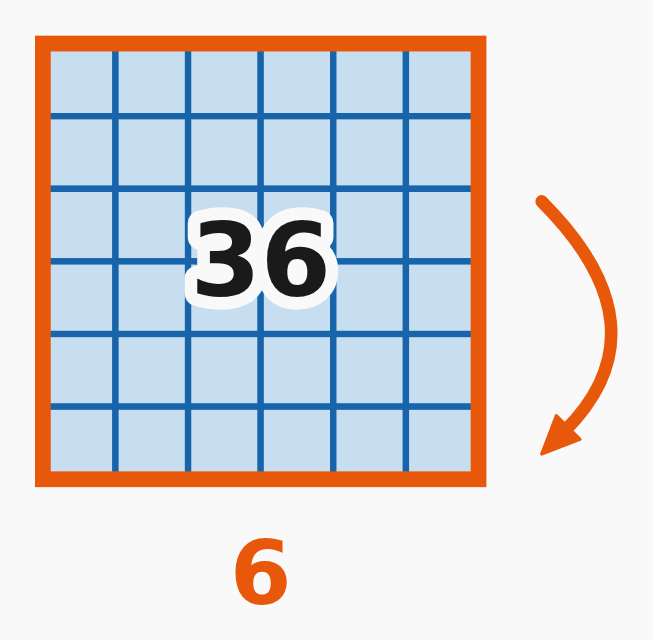
Squaring a number means multiplying it by itself: 5² = 5 · 5 = 25. The square root undoes that: √25 = 5. The number under the root sign is called the radicand.
Perfect squares
A perfect square is a number you get by squaring a whole number: 1, 4, 9, 16, 25, 36, 49, 64, 81, 100, … Their square roots are whole numbers, so √81 = 9 exactly. It helps to know the perfect squares up to 20² = 400 by heart.
A short example
√169 = 13, because 13 · 13 = 169. To check any square root, square your answer — you should get back the radicand.
Estimating roots that are not whole
Most numbers are not perfect squares. √50 is not a whole number, but we can estimate it. The nearest perfect squares are 49 = 7² and 64 = 8², so √50 is between 7 and 8. Since 50 is much closer to 49, √50 ≈ 7.
Cube roots
The cube root undoes cubing (raising to the third power): since 4³ = 4 · 4 · 4 = 64, the cube root ∛64 = 4. Perfect cubes are 1, 8, 27, 64, 125, 216, … and their cube roots are whole numbers.
Irrational numbers
The square root of a number that is not a perfect square — like √2 or √50 — cannot be written as a fraction. Its decimal goes on forever without repeating: √2 = 1.41421356… These are called irrational numbers. We usually leave them in root form (√2) for an exact answer, or round when we need a decimal.
Three rules that always help
- To check a square root, square your answer; to check a cube root, cube your answer.
- For an estimate, find the two nearest perfect squares (or cubes) and decide which one the radicand is closer to.
- A root is a whole number only when the radicand is a perfect square (or perfect cube); otherwise the answer is irrational.