In a year group, students learn French, Spanish and German. Some learn one language, some two, and some all three. The teacher wants to know how many learn none of them. With three sets it is easy to get confused. A Venn diagram helps you organise everything so that nobody is counted twice.
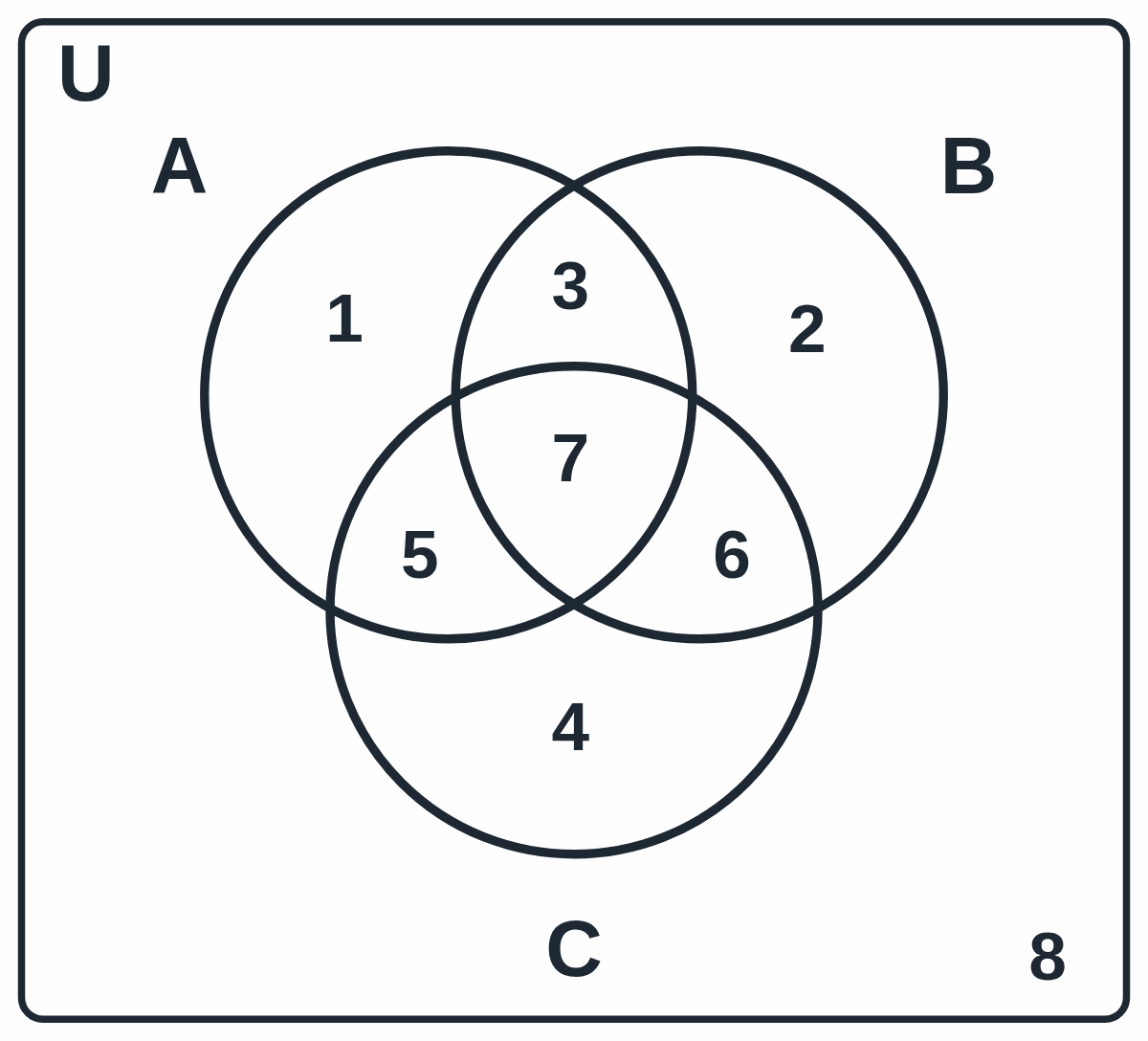
Three circles split the rectangle U into eight parts:
Part
Who is in it
1
only in A
2
only in B
4
only in C
3
in A and B, but not in C
5
in A and C, but not in B
6
in B and C, but not in A
7
in all three — A ∩ B ∩ C
8
outside all the circles
💡 Why eight? Each element “decides” three times: is it in A or not? In B? In C? That gives 2 × 2 × 2 = 8 possibilities. With two sets it was 2 × 2 = 4.
Shading expressions
The method is the same as with two sets: go through all eight parts and decide for each one whether it belongs to the set.
Worked example 1
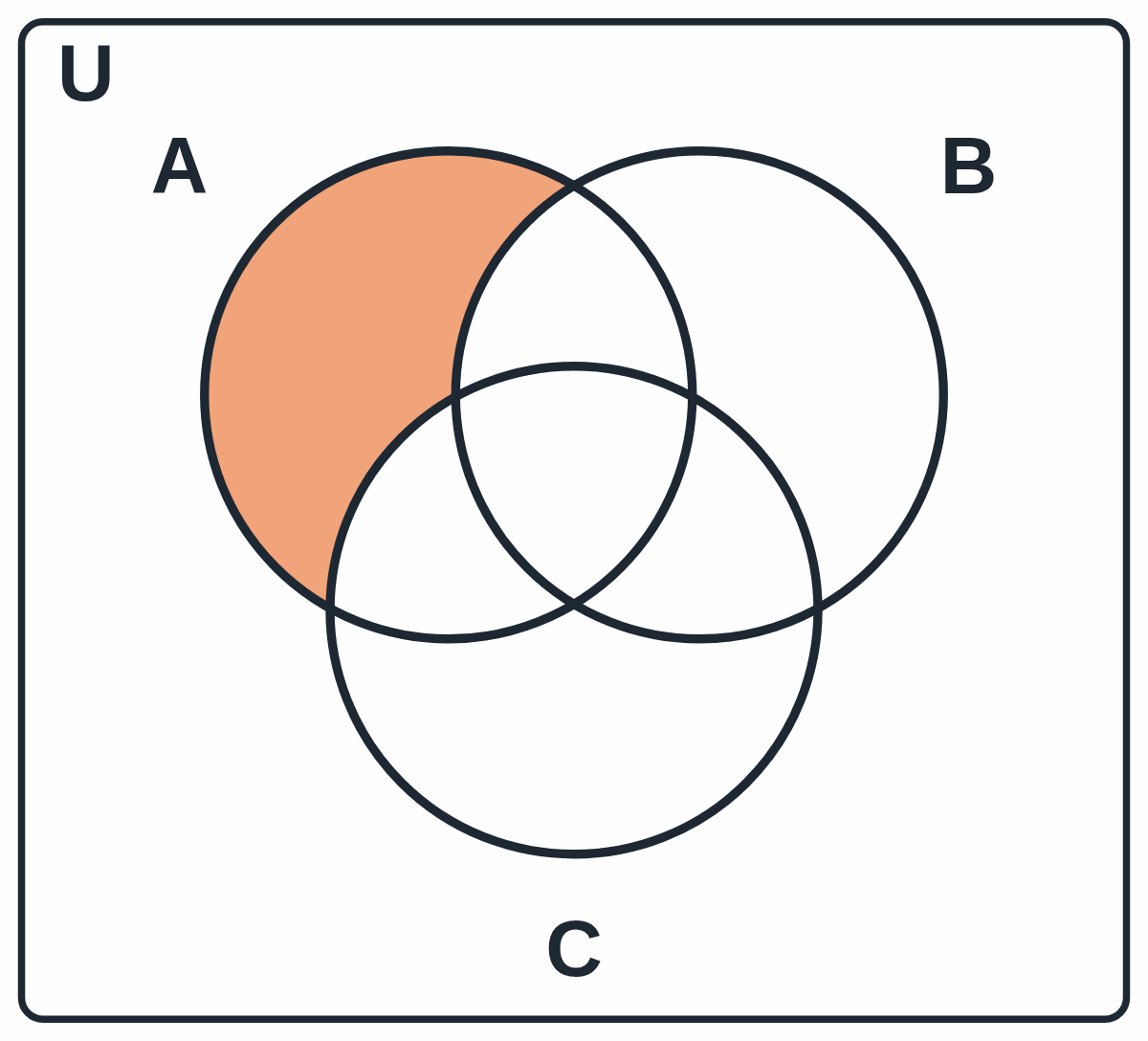
Shade the set A ∖ (B ∪ C).
The expression means: elements of A that are not in B and not in C.
From the parts of circle A (1, 3, 5, 7), throw out those that are also in B or in C (3, 5, 7).
Only part 1 is left.
Worked example 2
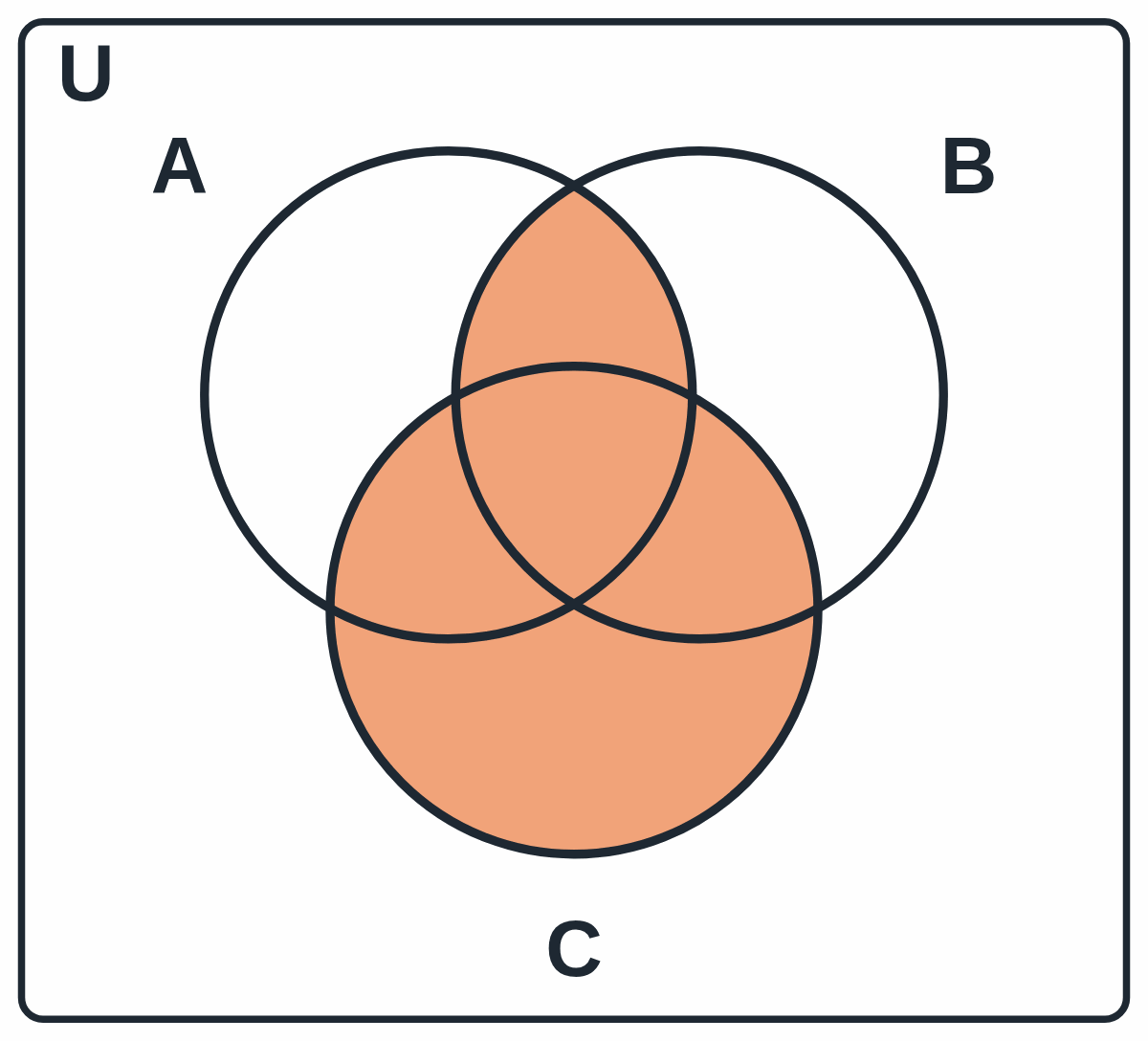
Shade the set (A ∩ B) ∪ C.
A ∩ B: parts 3 and 7.
C: parts 4, 5, 6, 7.
Union: parts 3, 4, 5, 6, 7.
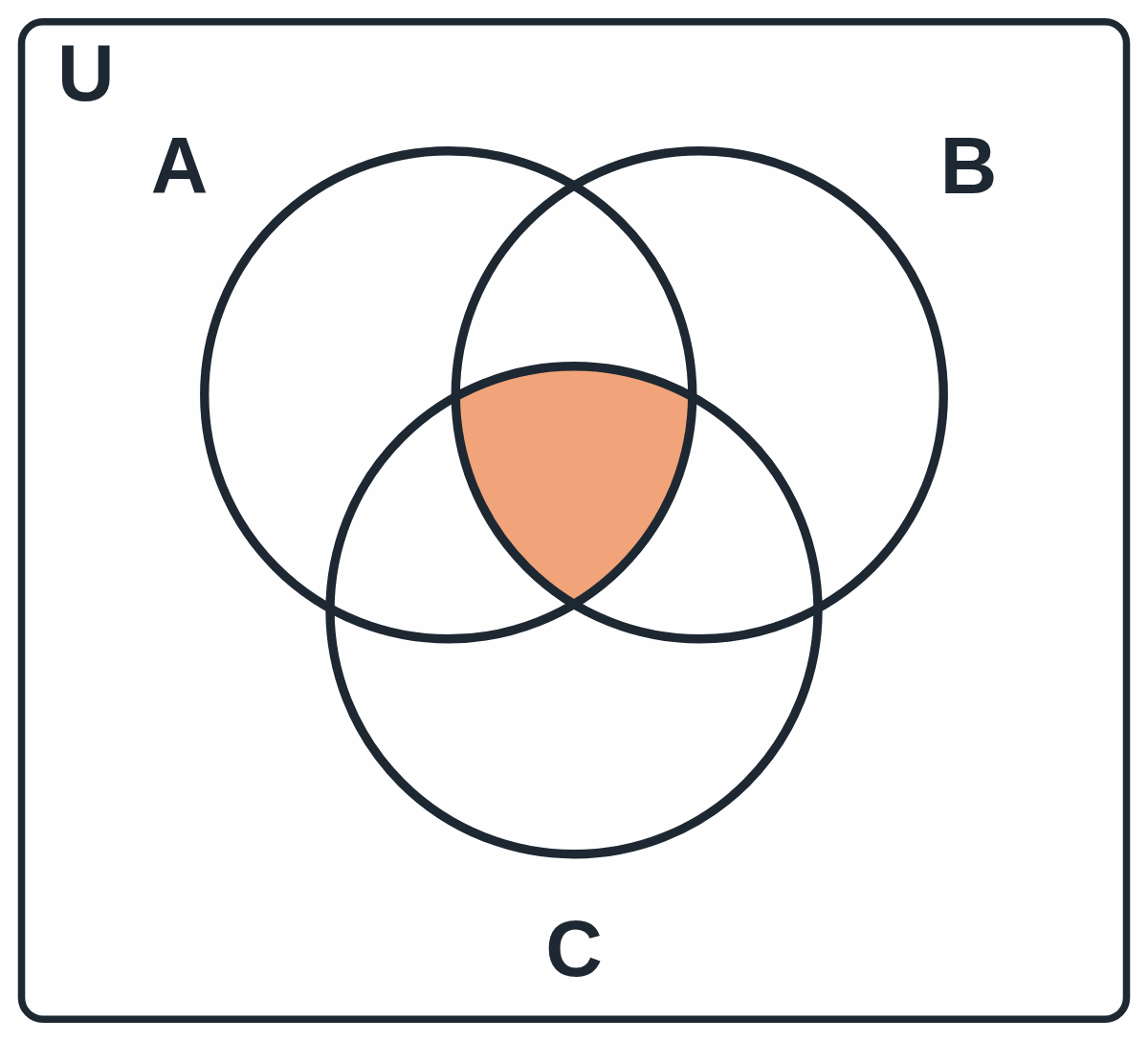
The intersection of all three, A ∩ B ∩ C, is only the middle part 7:
Reading numbers from the diagram
Sometimes each part shows how many elements are in it. Then you just add up the right parts.
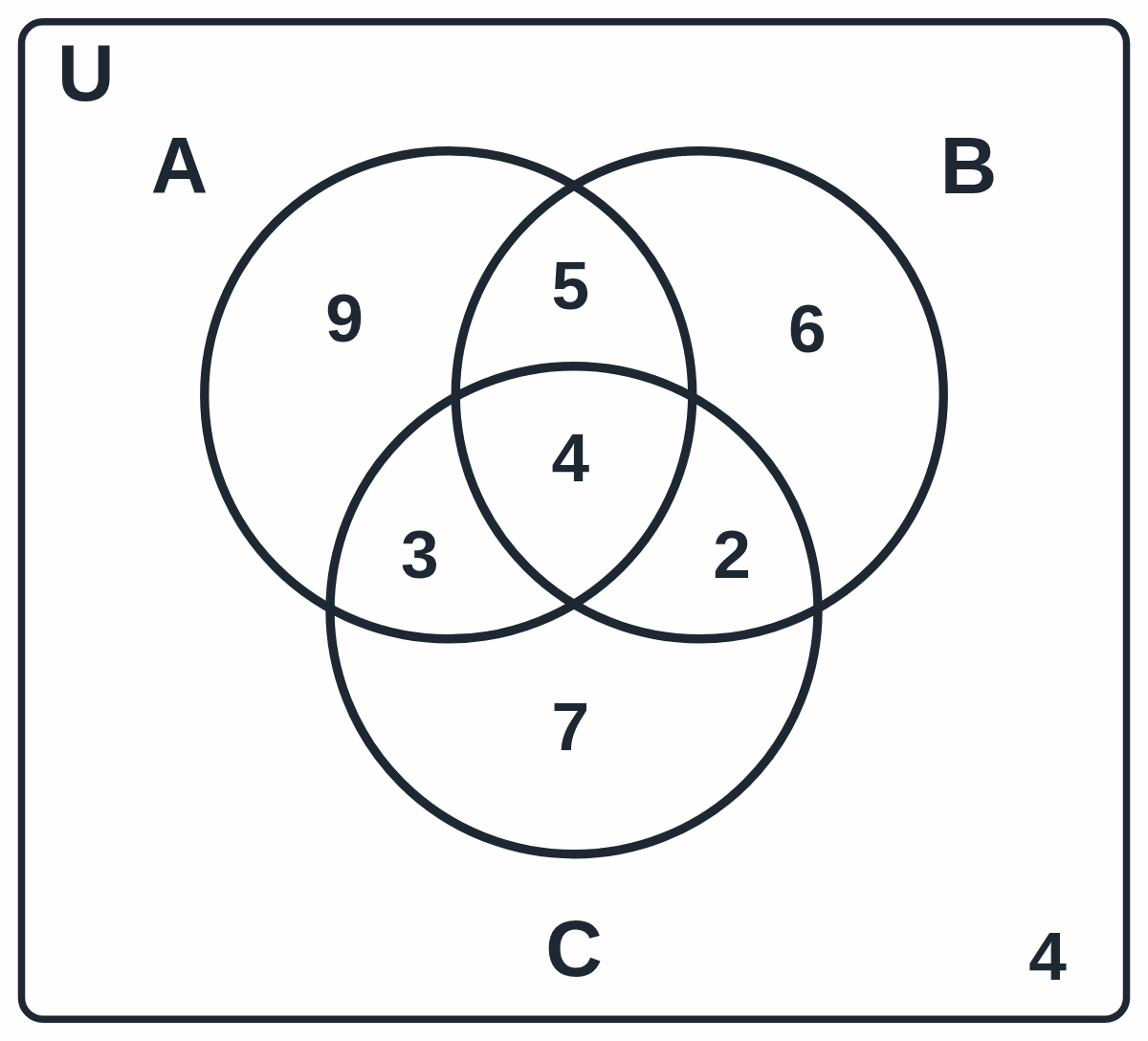
In the diagram below, the part “only A” shows 9, the middle shows 4, and so on.
n(A) = 9 + 5 + 3 + 4 = 21 (all the parts of circle A),
n(A ∩ B) = 5 + 4 = 9 (parts 3 and 7),
in exactly one set: 9 + 6 + 7 = 22,
in at least two sets: 5 + 3 + 2 + 4 = 14.
⚠️ A ∩ B includes the middle as well. Elements in all three sets are also in A and in B.
A word problem: filling in from the middle
There are 40 students in a year group. 21 learn French, 17 learn Spanish, 16 learn German. 9 learn French and Spanish, 7 learn French and German, 6 learn Spanish and German, and 4 learn all three languages. How many students learn none of these languages?
The golden rule: start in the middle and work outwards. The numbers like “French and Spanish” also include the students who learn all three.
The middle: all three languages — 4.
Pairs without the middle:
- French and Spanish, but not German: 9 − 4 = 5,
- French and German, but not Spanish: 7 − 4 = 3,
- Spanish and German, but not French: 6 − 4 = 2.
Only one language:
- only French: 21 − 5 − 3 − 4 = 9,
- only Spanish: 17 − 5 − 2 − 4 = 6,
- only German: 16 − 3 − 2 − 4 = 7.
At least one language: 4 + 5 + 3 + 2 + 9 + 6 + 7 = 36.
No language: 40 − 36 = 4 students.
The result is exactly the diagram above. 💡 Check: all eight numbers add up to 40 ✓.
For the curious: the number of elements in the union of three sets can also be found with a formula:
n(A ∪ B ∪ C) = n(A) + n(B) + n(C) − n(A ∩ B) − n(A ∩ C) − n(B ∩ C) + n(A ∩ B ∩ C)
21 + 17 + 16 − 9 − 7 − 6 + 4 = 36 ✓. The middle was counted three times in the first three numbers, then subtracted three times, so we have to add it back once. Filling in from the middle is safer, though, and easier to check.
Common mistakes
Filling in from the outside: “only French = 21” is wrong — the 21 includes students who learn another language too.
Forgetting the middle in the pairs: “French and Spanish = 9” includes the 4 students who learn all three.
Subtracting the middle twice: for “only A”, subtract the pairs without the middle, and the middle once.
No check: the eight parts must add up to the total.
Summary
Three circles make 8 parts (2 × 2 × 2).
When shading, go through all eight parts.
When counting, add up all the parts that belong to the set — including the middle.
Word problems: middle → pairs (minus the middle) → “only one” → outside. Finish with a check of the total.
Try it yourself
Which parts (1–8) make up the set (A ∪ B) ∖ C?
Which parts make up B ∩ C′?
Using the diagram with numbers above: how many elements are in B ∪ C?
A club has 50 members. 25 run, 20 cycle, 18 swim. 8 run and cycle, 6 run and swim, 5 cycle and swim, and 3 do all three sports. How many members do none of these sports? How many only run?
Answers
A ∪ B: parts 1, 2, 3, 5, 6, 7. Without C (throw out 5, 6, 7): parts 1, 2, 3.
B: parts 2, 3, 6, 7. Without C: parts 2, 3.
B ∪ C = everything in circles B and C: 6 + 5 + 2 + 4 + 7 + 3 = 27.
Middle 3. Pairs without the middle: 8 − 3 = 5, 6 − 3 = 3, 5 − 3 = 2. Only running: 25 − 5 − 3 − 3 = 14. Only cycling: 20 − 5 − 2 − 3 = 10. Only swimming: 18 − 3 − 2 − 3 = 10. At least one sport: 3 + 5 + 3 + 2 + 14 + 10 + 10 = 47. No sport: 3 members. Only running: 14 members.