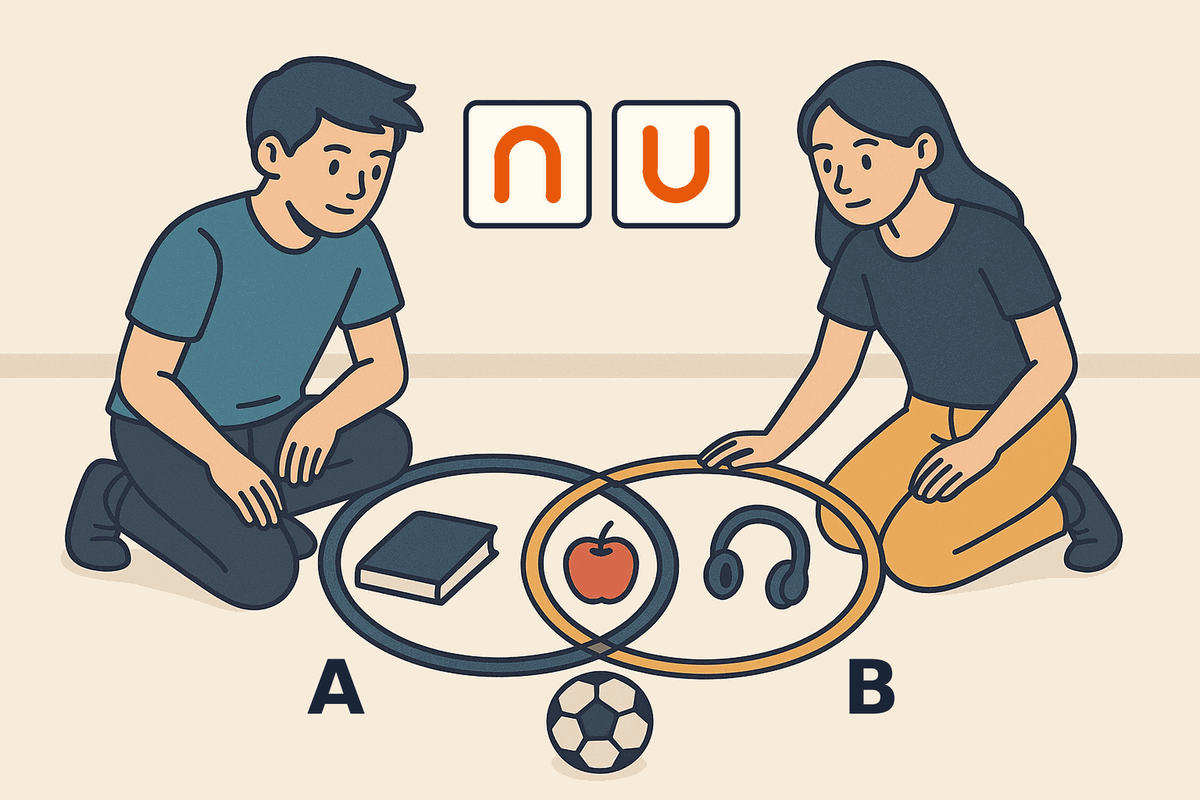
The PE teacher says: “Everyone who is at least 175 cm tall goes into the volleyball team.” She has not named anyone yet, but it is already clear who is in the team. You just need to measure each student.
This is exactly how a set works. A set is a collection of things where, for every thing, we can say clearly whether it belongs to the collection or not. The things that belong to a set are called its elements (or members).
Contents
- What is a set
- The symbols ∈ and ∉
- Describing a set by listing its elements
- Describing a set by a rule
- The empty set
- Finite and infinite sets
- Common mistakes
- Summary
- Try it yourself
- Answers
- Practise
What is a set
You can picture a set as a bag that we put things into. Two rules matter:
- For every thing, it must be clear whether it is in the bag or not.
- Each thing is in the bag at most once. We never count the same thing twice.
We name sets with capital letters: A, B, C, M … We write the elements inside curly brackets { }.
Examples:
- the set of weekend days: {Saturday, Sunday},
- the set of letters in the word “banana”: {b, a, n} — each letter is written only once,
- the set of even numbers less than 10: {2, 4, 6, 8}.
⚠️ “The set of good films” is not a set. Everyone decides differently what is good, so we cannot say clearly whether a film belongs.
The symbols ∈ and ∉
The fact that 4 belongs to the set A = {2, 4, 6, 8} is written:
4 ∈ A — read “4 is an element of A” or “4 belongs to A”.
The fact that 5 does not belong to it is written:
5 ∉ A — read “5 is not an element of A”.
💡 The symbol ∈ looks like the letter “e” for “element”. The crossed-out ∉ means the opposite, just like ≠ means “not equal”.
Describing a set by listing its elements
The simplest way is to write out all the elements. This is called listing (or roster) notation:
A = {1, 2, 3, 6}
When listing:
- Order does not matter. {1, 2, 3, 6} and {6, 3, 2, 1} are the same set.
- Elements are not repeated. We do not write {1, 2, 2, 3} — the correct form is {1, 2, 3}.
Listing works well when there are only a few elements. If there are many but they follow a pattern, we can use three dots: {1, 2, 3, …, 100}.
Describing a set by a rule
The second way is to give a rule that all the elements follow — and nothing else does. This is called set-builder notation:
A = {x ∈ ℕ | x is a factor of 6}
Read it as: “A is the set of all x in the natural numbers such that x is a factor of 6.”
The notation has three parts:
| Part | Meaning |
|---|---|
| x ∈ ℕ | which numbers we choose from (here the natural numbers 1, 2, 3, …) |
| | | “such that” (some books use a colon : instead) |
| x is a factor of 6 | the rule that x must follow |
We find the elements by trying the numbers one by one: 1 divides 6 ✓, 2 ✓, 3 ✓, 4 ✗, 5 ✗, 6 ✓. Bigger numbers do not divide 6. So A = {1, 2, 3, 6}.
Worked example 1
List the elements of B = {x ∈ ℤ | −2 ≤ x < 3}.
- We choose from the integers ℤ — so zero and negative numbers count too.
- The rule: x is greater than or equal to −2 and less than 3.
- With “≤” the end number is included: −2 is in the set.
- With “<” the end number is not included: 3 is not in the set.
- B = {−2, −1, 0, 1, 2}.