A power is shorthand for repeated multiplication:
a^3 = a · a · a
a^5 = a · a · a · a · a
If you want to multiply two powers of the same base, you do not have to
expand everything — there is a shortcut.
Rule 1 — product of powers
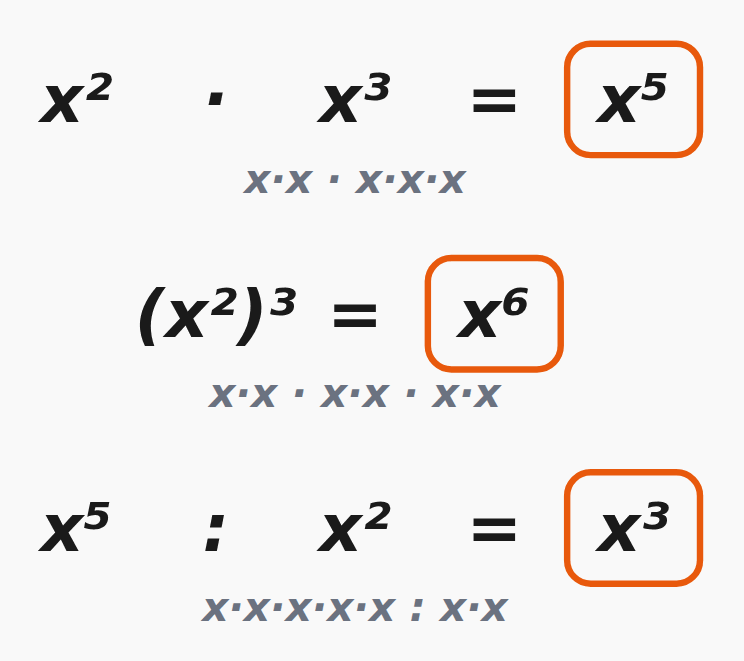
a^m · a^n = a^(m+n)Think about why: `a^3 · a^2 = (a·a·a)·(a·a) = a^5`. The exponents add.
Common slip-up: it only works for the same base. `a^3 · b^2` does
not combine.
Rule 2 — quotient of powers
a^m ÷ a^n = a^(m−n), when m ≥ na^5 ÷ a^2 = (a·a·a·a·a) ÷ (a·a) = a·a·a = a^3For now we keep `m ≥ n` so the result is still a "regular" power. (At a
later level, `a^(−k) = 1 / a^k` gives meaning to negative exponents.)
Rule 3 — power of a power
(a^m)^n = a^(m·n)(a^2)^3 = a^2 · a^2 · a^2 = a^6The exponents multiply.
A short summary table
| operation | rule | example |
| product | `a^m · a^n = a^(m+n)` | `a^3 · a^4 = a^7` |
| quotient (m ≥ n) | `a^m ÷ a^n = a^(m−n)` | `a^7 ÷ a^3 = a^4` |
| power of a power | `(a^m)^n = a^(m·n)` | `(a^3)^2 = a^6` |
Worked example
(a^2)^3 · a^4 ÷ a^5
= a^6 · a^4 ÷ a^5    (power of power)
= a^10 ÷ a^5         (product)
= a^5                (quotient)