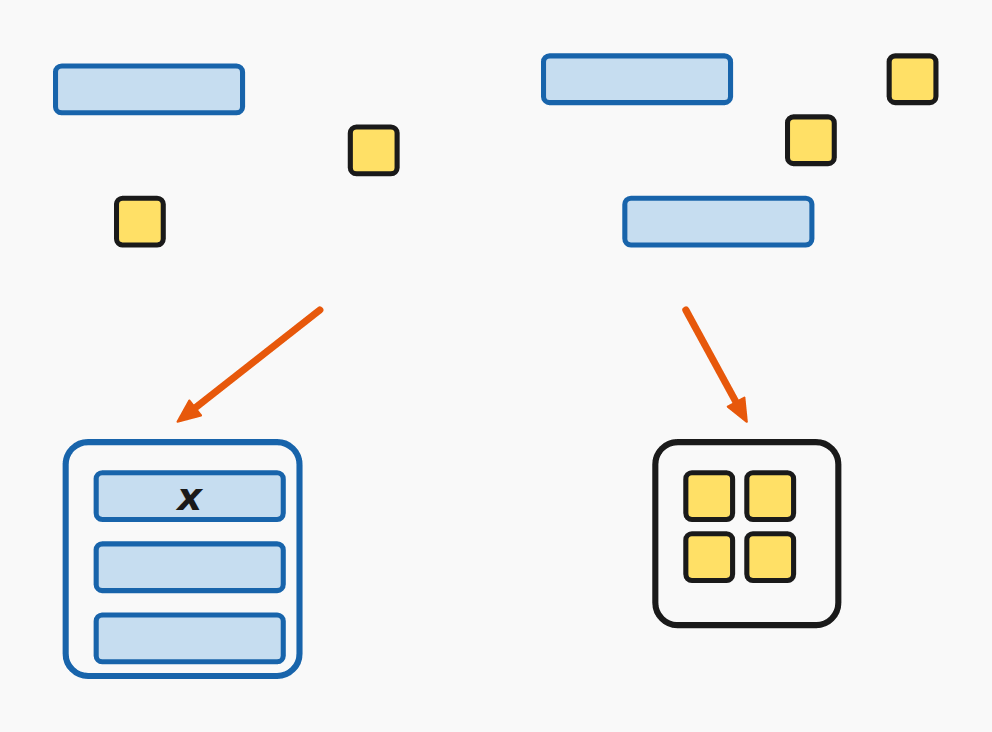
These three moves let you rewrite any linear expression in a cleaner
form. Mastering them is the entire grade-7 algebra agenda — everything
later (linear equations, ratios with variables, basic identities) builds
on these.
1) Combining like terms
Like terms are terms with the **same variable raised to the samepower**. For example:
- `3a` and `−a` are like terms (both are "some number" of `a`).
- `3a` and `5` are not like terms (one has the variable, one does not).
- `3a` and `3a²` are not like terms (different powers).
To combine, add the coefficients:
3a + 5 − a + 2 = (3 − 1)a + (5 + 2) = 2a + 7Tip: rewrite "−a" as "−1a" mentally. Then "(3 − 1)a = 2a" is automatic.
2) Expanding brackets — the distributive property
a · (b + c) = a·b + a·cExamples:
3(2x − 4)  = 6x − 12
−2(x + 5)  = −2x − 10
4(3a − 7) − 2 = 12a − 28 − 2 = 12a − 30
Sign care: when the factor in front is negative, the sign of every
term inside the brackets flips.
3) Factoring a common factor
This is the distributive property read in reverse:
a·b + a·c = a · (b + c)To factor `6x + 9`:
- Find `gcd(6, 9) = 3`.
- Pull it out: `6x + 9 = 3·(2x + 3)`.
- Check by expanding: `3·2x + 3·3 = 6x + 9`. ✓
The factored form is often easier to use — for example when solving
equations like `6x + 9 = 0`, the form `3·(2x + 3) = 0` shows immediately
that `2x + 3 = 0`.
A common pattern — expand then combine
Many longer expressions need both moves: expand first, then combine
like terms.
2(x + 3) + 5(x − 1)
= 2x + 6 + 5x − 5
= 7x + 1