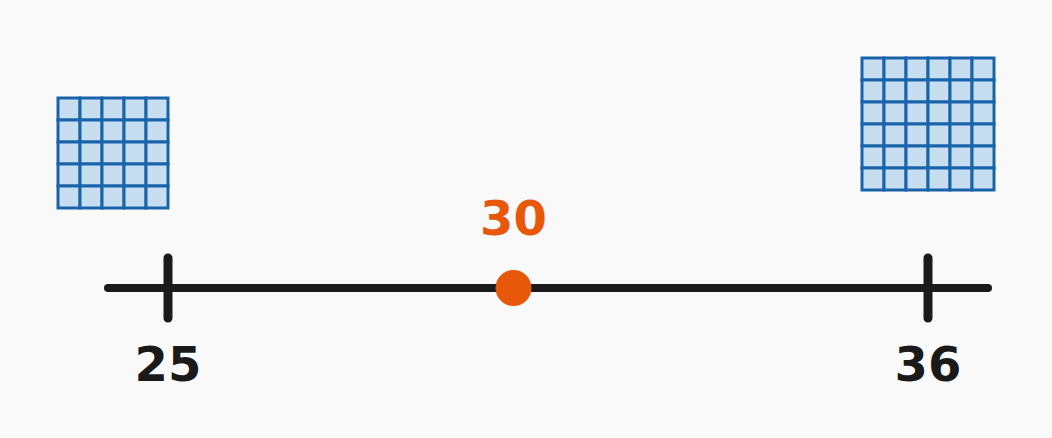
Most numbers are not perfect squares, so their square roots are not whole numbers. For example √20 is not a whole number — but we can still say roughly how big it is.
Trap it between two perfect squares
To estimate √20, find the perfect squares just below and just above 20:
16 < 20 < 25, so √16 < √20 < √25, which means 4 < √20 < 5.
So √20 is between 4 and 5. Because 20 is closer to 16 than to 25, √20 is a bit above 4 — about 4.5. (A calculator gives 4.47.)
Rounding to the nearest whole number
If a question asks for the nearest whole number, pick the closer of the two boundaries. Here 20 is closer to 16, so √20 rounds to 4.
Three rules that always help
- Find the perfect square just below and just above the number.
- The square root lies between the two whole-number roots of those perfect squares.
- Compare the gaps to decide which whole number it is closer to.
Keep going
- Practice: Estimate a square root
- Back to the square roots overview