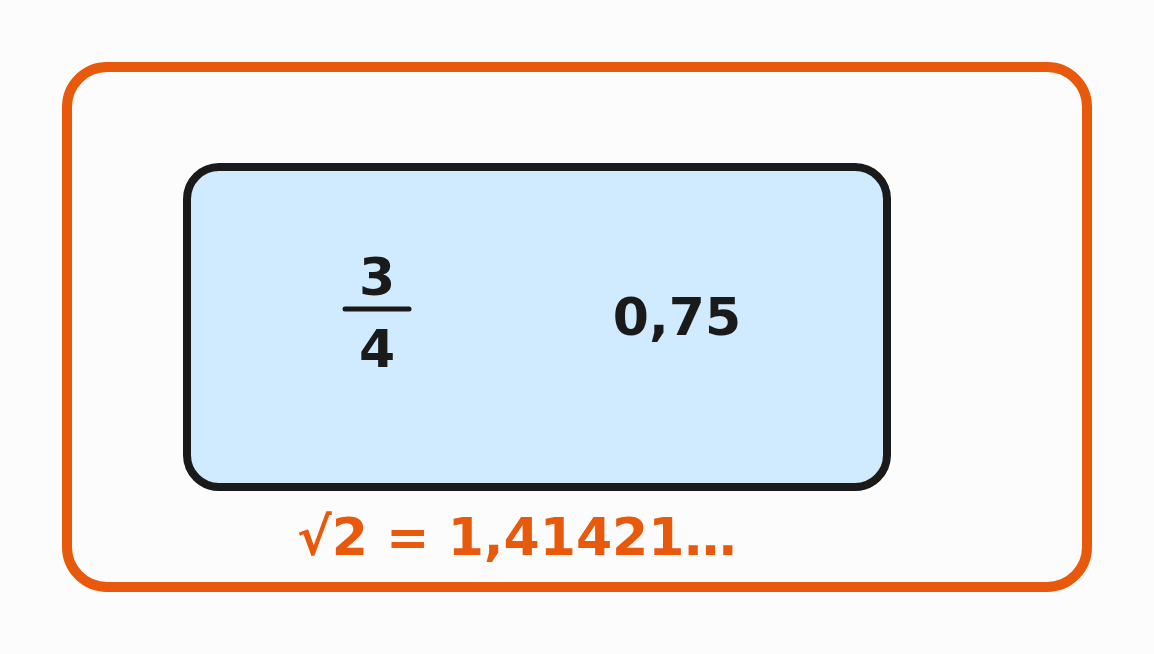
A rational number is any number you can write as a fraction of two whole numbers. Integers (like 7 = 7/1), simple fractions (like 3/4) and terminating or repeating decimals are all rational.
When is a root rational?
The square root of a perfect square is rational — √36 = 6 is a whole number. But the square root of a number that is not a perfect square, like √2 or √7, cannot be written as a fraction. Its decimal goes on forever without repeating. Numbers like this are called irrational.
The famous number π is also irrational: 3.14159… never settles into a repeating pattern.
Do not be fooled by the symbol
A √ sign does not automatically make a number irrational. √49 is rational (it equals 7); √50 is irrational. Always check whether what is under the root is a perfect square.
Three rules that always help
- Rational = can be written as a fraction of whole numbers.
- Roots of perfect squares are rational; roots of non-perfect squares are irrational.
- π is irrational.
Keep going
- Practice: Rational or irrational?
- Practice: Evaluate a root expression
- Back to the square roots overview