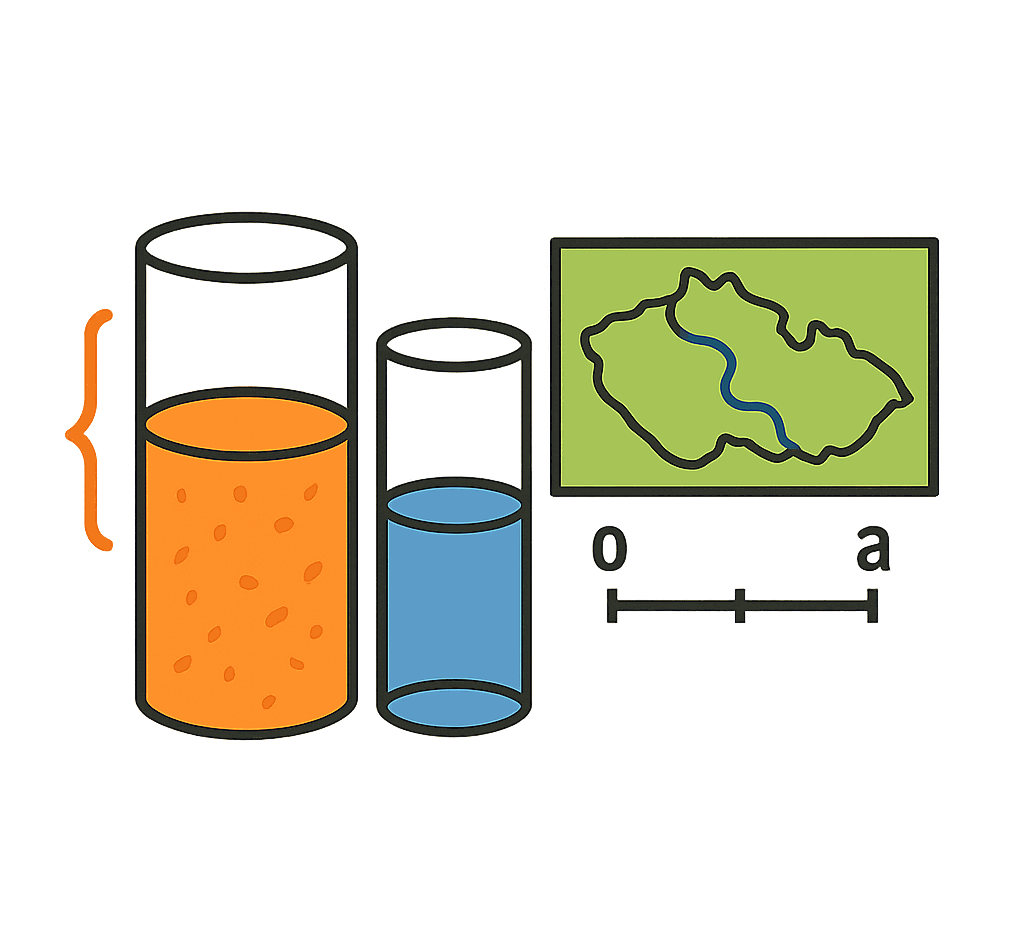
Ratios in maths aren't there just to give you something to calculate — they appear everywhere around you. Here are three places where ratios are essential.
Recipes — mixing
In recipes, ingredients are mixed in a fixed ratio. For example, pancake batter:
flour : milk = 1 : 2
If you have 200 g of flour, you need 400 g of milk. For 600 g of flour, you need 1200 g (= 1.2 l) of milk. The ratio stays the same, only the total amount changes.
Squash — concentrate and water
Squash is usually diluted in a ratio like 1 : 4 (1 part squash, 4 parts water).
For 50 ml of squash, add 200 ml of water → 250 ml ready to drink.
To make a full litre, how much squash? Rule of three: 250 ml ready = 50 ml squash, so 1000 ml ready = `(50 · 1000) ÷ 250 = 200 ml squash`.
Map scale
A scale of 1 : 10 000 means 1 cm on the map corresponds to 10 000 cm = 100 m in reality.
4 cm on the map = 40 000 cm = 400 m in reality.
A scale of 1 : 100 000 is used for road maps: 1 cm on the map = 1 km in reality.
Ratios change proportion, not amount
A ratio describes the relationship between two quantities, not their absolute size. So:
- The recipe works the same for 4 people or 40 — you just scale it.
- A map works for any size of area — only the resolution changes, not the ratio.