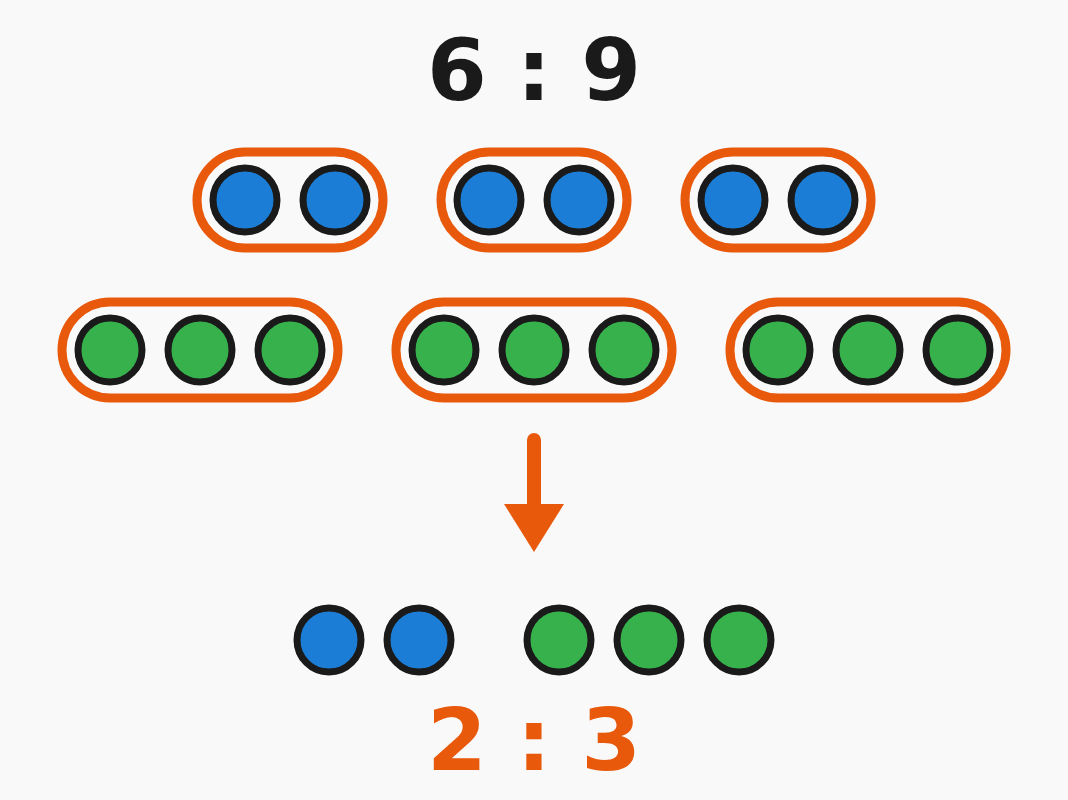
The ratios 2 : 3 and 4 : 6 are really the same. So is 20 : 30. They are called equivalent ratios — different ways of writing the same relationship between two quantities.
When are two ratios equivalent
Two ratios `a : b` and `c : d` are equivalent exactly when:
a · d = b · c (cross-multiplication)
Example: `2 : 3` and `4 : 6` → `2 · 6 = 12`, `3 · 4 = 12` ✓. Equivalent.
Counter-example: `2 : 3` and `4 : 7` → `2 · 7 = 14`, `3 · 4 = 12` ✗. Not equivalent.
Simplifying — the simplest form
Simplifying means dividing both parts of the ratio by the same number. The ratio doesn't change, just gets shorter. Example. Simplify `12 : 18`.- Find the GCD (greatest common divisor) of 12 and 18 → 6.
- Divide both parts by 6: `12 ÷ 6 = 2`, `18 ÷ 6 = 3`.
- Simplest form: 2 : 3.
Step by step
- Find a common divisor of both parts.
- Divide both by the same number.
- Repeat until you can't simplify further (the parts share no common factor).
Example: sharing money
Tom and Mia split £30 in the ratio 18 : 12. What's the simplified ratio?
- GCD(18, 12) = 6.
- `18 ÷ 6 : 12 ÷ 6 = 3 : 2`.
Mia got 3 parts, Tom 2 (or vice versa, depending on the problem).
Common traps
- Ratio 4 : 6 and fraction 4/6 are written differently, but simplify the same way.
- One simplification isn't always enough. `12 : 18 → 6 : 9` is still not the simplest (GCD(6, 9) = 3 → 2 : 3).
- Ratio with units: convert to the same unit first. "30 cm : 1 m" = "30 cm : 100 cm" = 30 : 100 = 3 : 10.