You'll meet this problem all the time: "A recipe for 4 people needs 200 g of flour. How much flour for 10 people?" When the number of people grows, the flour grows in the same proportion. We call this direct proportion.
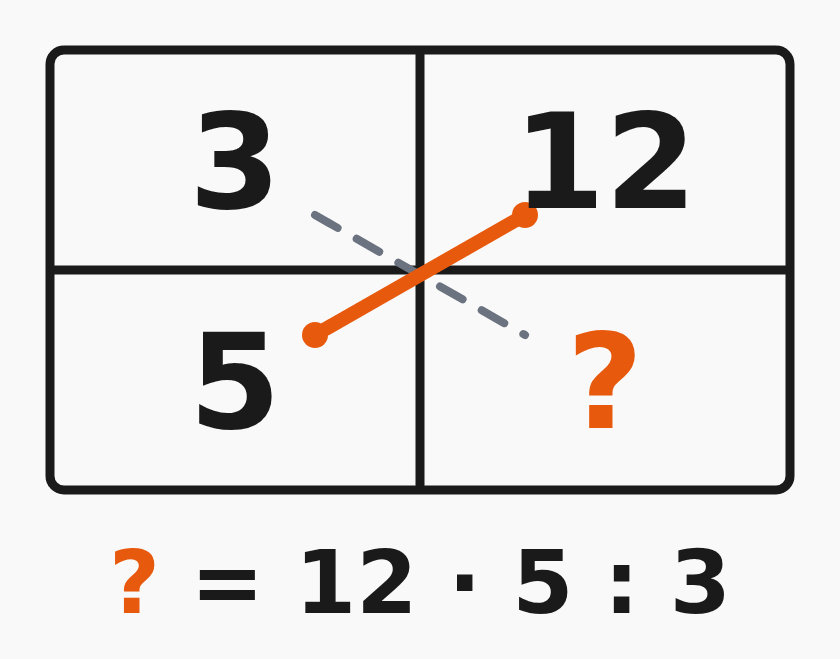
The rule of three is the formula that turns three known values into the fourth one.
The main idea
When two quantities are in direct proportion, their ratio stays the same:
`4 people ↔ 200 g` is the same ratio as `10 people ↔ ? g`.
This gives:
`4 / 200 = 10 / ?` or equivalently `? = (200 × 10) / 4`.
Step by step
- Write down all four spots as a proportion: the three knowns and the unknown.
- Cross-multiply: top of the unknown side × bottom of the known side.
- Divide by the other top number.
For our example: `? = 200 × 10 ÷ 4 = 2000 ÷ 4 = 500 g`.
A clean way to lay it out:
   people      flour
   4    ──►    200
   10   ──►     ?
The missing value is always `? = (10 × 200) ÷ 4`.
Example 1 — a recipe
A recipe for 6 people needs 150 g of butter. How much butter for 9 people?
- proportion: `6 / 150 = 9 / ?`
- result: `? = 150 × 9 ÷ 6 = 1350 ÷ 6 = 225 g`
Example 2 — metres for money
5 metres of ribbon cost £2. How much for 12 metres?
- proportion: `5 / 2 = 12 / ?`
- result: `? = 2 × 12 ÷ 5 = 24 ÷ 5 = £4.80`
Example 3 — speed
A cyclist covers 45 km in 3 hours. How far in 5 hours at the same speed?
- proportion: `3 / 45 = 5 / ?`
- result: `? = 45 × 5 ÷ 3 = 225 ÷ 3 = 75 km`
When is the proportion **direct**?
Direct proportion means: as one quantity grows, the other grows in the same proportion. For example:
- More people → more food (recipe).
- More metres → more money (ribbon).
- More time → more distance (at a constant speed).
Sanity check
Always ask: does the answer make sense?
- Twice the people → twice the flour.
- Three times the metres → three times the money.
If you get less flour for more people, something is wrong.