Numbers above 10,000
In fifth grade you'll meet numbers bigger than ten thousand. You'll learn how to read them, write them, and work with them. On this page you'll find everything you need – from the place value of digits to rounding.
What are large numbers?
You run into large numbers every day: the population of a city, the distance to the Sun in kilometers, the price of a car, or someone's yearly earnings. All of them can be written using the ten digits (0 – 9) – just in many different places.
For example, the number 2,457,891 has seven digits. Each digit sits in its own place and has its own value depending on where it stands.
We read the number as: two million four hundred fifty-seven thousand eight hundred ninety-one.
What's in this chapter
In this topic you'll learn, step by step:
- Digit at a given place – how to find out which digit stands, for example, at the thousands place.
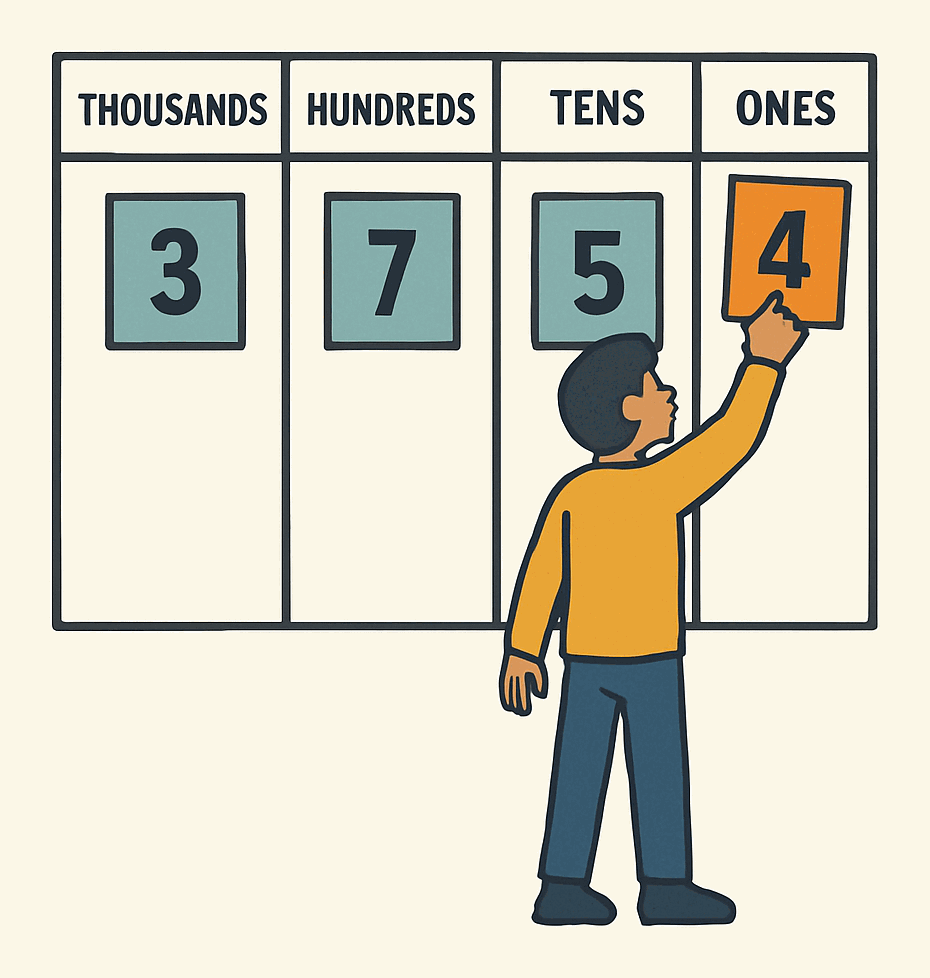
- Place of a digit in a number – the reverse: you know the digit and you're looking for which place it sits in.
- Expanded form of a number – how to write a number as a sum of the values of its individual places.
- Rounding large numbers – when and how to round to tens, hundreds, thousands, or higher places.
Why does this matter?
Understanding large numbers will help you:
- read the news – populations, distances, prices,
- make estimates – quickly work out an approximate answer without exact calculation,
- get ready for fractions and decimals – where you also need to know what place each digit holds.
Practice it
Everything you read in the articles, you can try right away:
- Digit at a given place – find the digit at the place the generator asks about.
- Which place is the digit at? – pick the correct place from several options.
- Expanded form of a number – break a number into a sum of its places.
- Rounding large numbers – round a number to the given place.
Once you've mastered all four exercises – place value, expanded form, and rounding – you can try a short quiz – one problem from each area.