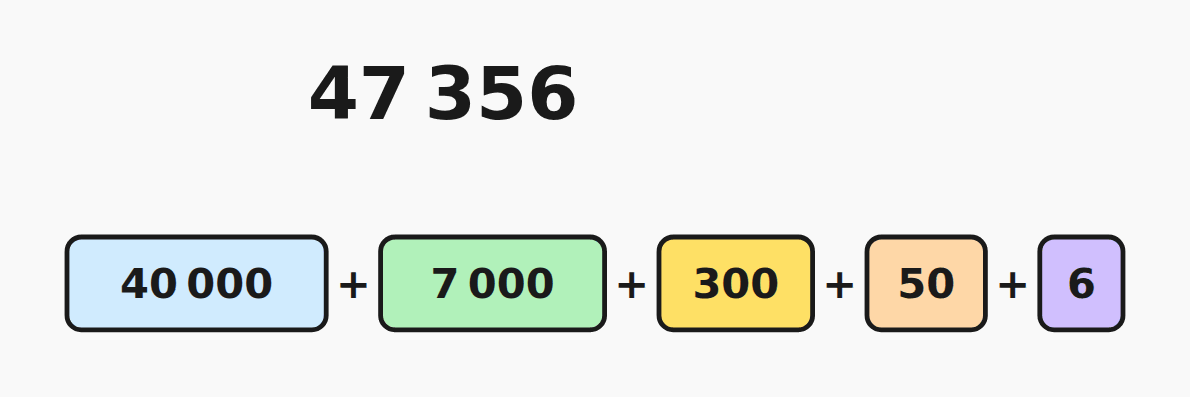
Expanded form (sometimes also called
positional notation or
place-value decomposition) lets you see the real value each digit carries in a number.
Where it comes from
When you write the number 45,237, each of its digits hides a value that depends on its place:
- 4 is at the ten thousands place → its value is 4 × 10,000 = 40,000
- 5 is at the thousands place → 5 × 1,000 = 5,000
- 2 is at the hundreds place → 2 × 100 = 200
- 3 is at the tens place → 3 × 10 = 30
- 7 is at the ones place → 7 × 1 = 7
When we add all these values together, we get the same number back:
45237=40000+5000+200+30+7
And that is the expanded form of the number 45,237.
The general procedure
- Find out how many digits the number has and which places appear in it (see Digit at a given place).
- For each non-zero digit, write its value as the product of the digit and the value of its place.
- Add the individual values together with +.
- Start with the largest place and end with the ones.
Example 1 – a number without zeros
Problem: Write the number
368,524 in expanded form.
368524=300000+60000+8000+500+20+4
Example 2 – a number with zeros
Problem: Write the number
40,207 in expanded form.
We can see that the digits at the thousands and tens places are 0. Zero places are left out of the expanded form – they carry no value.
40207=40000+200+7
Example 3 – a larger number
Problem: Write the number
2,075,083 in expanded form.
First let's identify the places:
- millions: 2
- hundred thousands: 0
- ten thousands: 7
- thousands: 5
- hundreds: 0
- tens: 8
- ones: 3
We leave out the zero places. What remains are the millions, ten thousands, thousands, tens, and ones:
2075083=2000000+70000+5000+80+3
- It shows you why a number looks the way it does – every digit has a clear value.
- It makes adding and subtracting large numbers easier – once you know that 40,000 + 5,000 is 45,000, adding 45,237 + 3,000 is almost automatic.
- It prepares you for decimals, where the same rule also applies to decimal places (tenths, hundredths…).
Related articles
Practice it