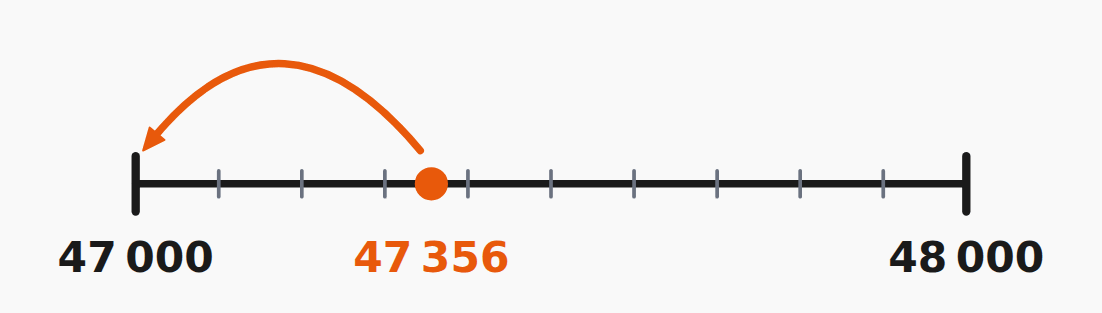
To round means to replace an exact number with one that's easier to remember. For example, instead of 42,871 we say
43,000. The number is a bit less precise, but it still gives you a good idea of the size we're talking about.
Why we round numbers
- For estimates (how much will it cost, how many people will fit, …).
- In news and statistics – "65,000 people live in the city" is easier to grasp than "65,317 people."
- For mental math – round numbers are easier to work with in your head.
The rounding rule
We always round to a chosen place (for example, to tens, hundreds, thousands…). The key is the digit immediately after that place.
- If that digit is 5 or more → round up (increase the digit at the chosen place by 1 and replace everything to its right with zeros).
- If it's less than 5 → round down (leave the digit at the chosen place and replace everything to its right with zeros).
5 or more → up ⬆️
The digit at the chosen place increases by 1.
Less than 5 → down ⬇️
The digit at the chosen place does not change.
Example 1 – rounding to thousands
Problem: Round the number
45,678 to the nearest thousand.
- The place we are rounding to is the thousands: the digit at this place is 5.
- The digit right after it (hundreds) is 6.
- Since 6 ≥ 5, we round up: we change the 5 to a 6 and replace the hundreds, tens, and ones with zeros.
Result: 45,678 ≈
46,000.
Example 2 – rounding to ten thousands
Problem: Round the number
128,432 to the nearest ten thousand.
- The digit at the ten thousands place is 2.
- The digit right after it (thousands) is 8.
- 8 ≥ 5 → we round up: the 2 becomes a 3, and the thousands, hundreds, tens, and ones are all zeros.
Result: 128,432 ≈
130,000.
Example 3 – rounding down
Problem: Round the number
7,249 to the nearest hundred.
- The digit at the hundreds place is 2.
- The digit right after it (tens) is 4.
- 4 < 5 → we round down: the 2 stays, and the tens and ones are zeros.
Result: 7,249 ≈
7,200.
Example 4 – rounding that changes several places
Problem: Round the number
39,961 to the nearest hundred.
- The hundreds digit is 9.
- The digit after it (tens) is 6 → we round up.
- 9 + 1 = 10 → the digit carries over: the hundreds become 0 and the thousands jump from 9 to 10, which carries over again – the ten thousands go from 3 to 4.
Result: 39,961 ≈
40,000.
Rounding like this is said to carry over across several places.
Overview of rounding the number 45,678
| Round to… | The deciding digit is… | Result |
| tens | ones (8) – up | 45,680 |
| hundreds | tens (7) – up | 45,700 |
| thousands | hundreds (6) – up | 46,000 |
| ten thousands | thousands (5) – up | 50,000 |
Related articles
Practice it