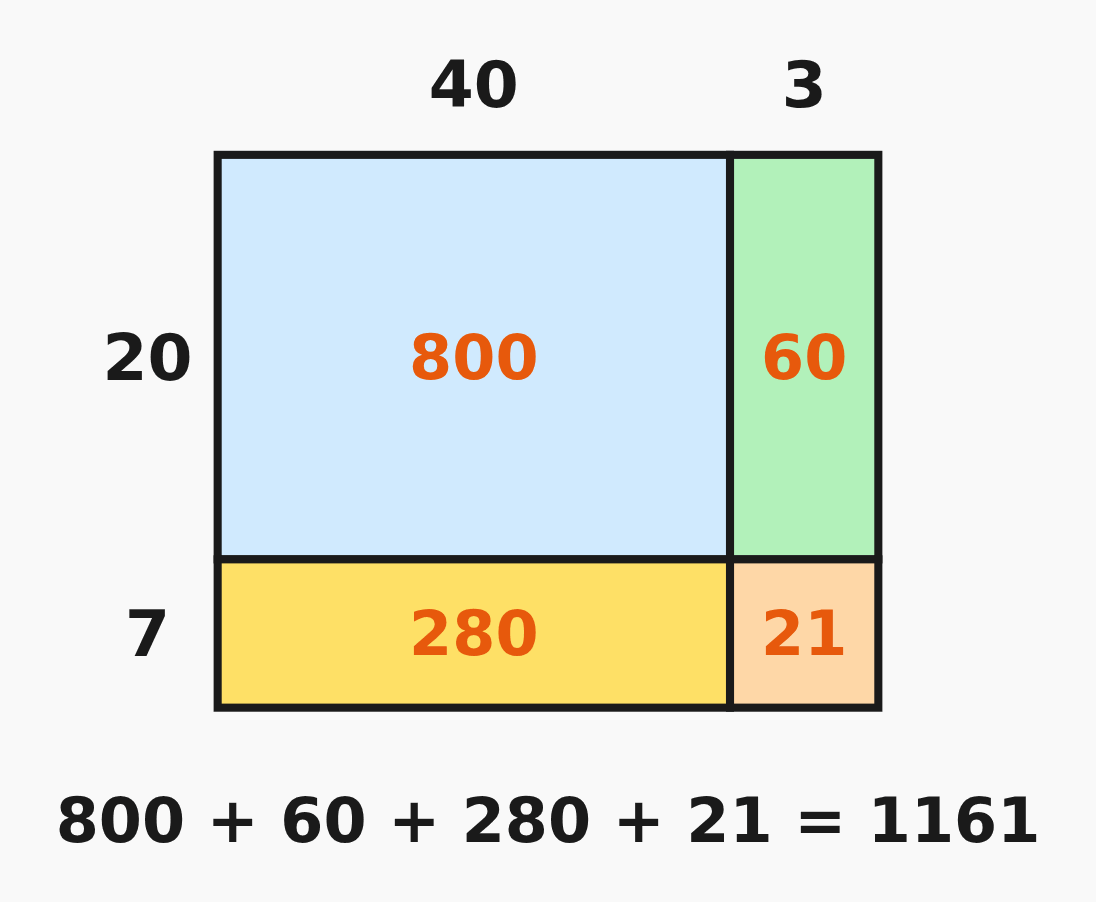
Long multiplication is not just a recipe to follow. It is built on one idea you already know — place value — combined with the distributive property of multiplication over addition.
Splitting the bottom factor
When you multiply by , you can break the number into its place-value parts:
By the distributive property, multiplying any number by is the same as:
That is exactly one partial product per digit of the bottom factor. For two-digit factors you get two partial products, for three-digit you get three, for four-digit you get four.
Why do we shift each partial product?
Take a closer look at the second partial product, . Multiplying by is the same as multiplying by and then by :
Multiplying by shifts every digit one place to the left (and adds a zero in the ones place). In the column layout we save ink and just leave the rightmost cell empty — visually that is the same shift.
For three-digit factors we use:
- stays where it is.
- → shifted one place left.
- → shifted two places left.
Each digit further to the left in the bottom factor corresponds to one extra place of shift in the partial product.
Why each partial product can be one digit longer
A 4-digit number multiplied by a single digit can produce a 5-digit answer. For example:
So when you write a partial product below a 4-digit top factor, leave room for one extra digit on the left to fit the carry. The exercise generator on this site does that automatically — the partial-product fields always have one more cell than the top factor has digits.
The final step: addition
Once every partial product is written down with the correct shift, you simply add them up column by column. The result has at most digits.
For — that is 8 digits, exactly as expected (4 + 4).
Putting it all together
To multiply where has digits :
- Compute partial products: .
- Shift the -th partial product places to the left.
- Add them all up.
That is the whole algorithm — and now you know why it works.
Read more
- Multiplication by a multi-digit number – guide
- Step-by-step procedure
- Worked examples and common mistakes