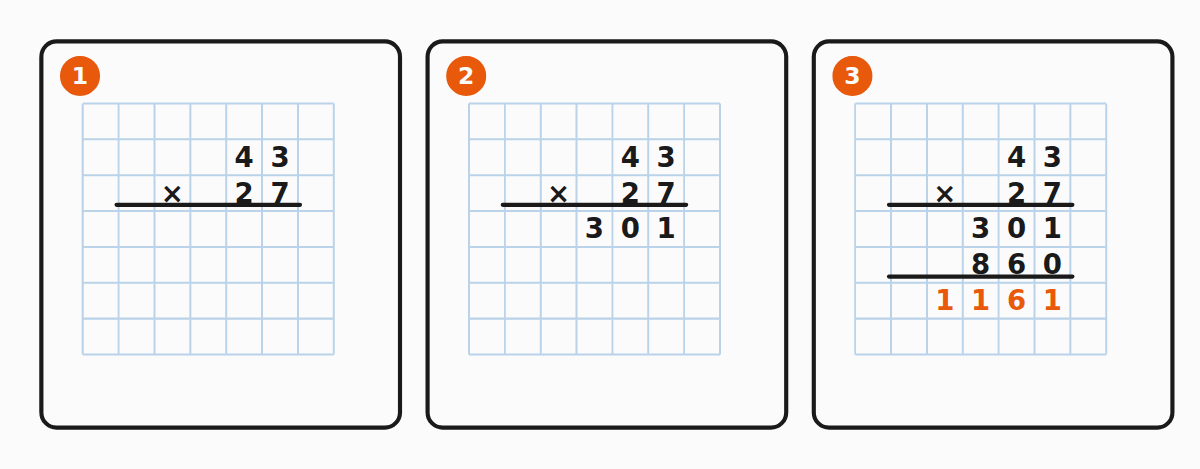
Here are three fully worked problems, one for each difficulty level you will meet on the exam. Each example uses the same recipe from Step-by-step procedure.
Example 1 – 2-digit bottom factor
Partial products:
- (shifted one place left)
1234
× 56
7404
6170
69104
Example 2 – 3-digit bottom factor
Partial products:
- (shifted one place left)
- (shifted two places left)
2135
× 247
14945
8540
4270
527345
Example 3 – 4-digit bottom factor
Partial products:
- (shifted one place left)
- (shifted two places left)
- (shifted three places left)
So .
Common mistakes
Watch out for these slip-ups — almost every wrong answer comes from one of them.
- Forgetting to shift. If you forget to shift the second (or third, or fourth) partial product, you will be adding numbers that line up incorrectly. Each new partial product moves one extra place to the left.
- Losing a carry during multiplication. When multiplying a digit and the result is two digits, write the ones digit and carry the tens to the next position. After the last digit, do not forget to write the carry as a final digit on the left.
- Mixing up addition carries with multiplication carries. When you finally add the partial products, you might also have to carry. These carries are independent of the ones you used during multiplication.
- Misreading place values. The rightmost digit of the bottom factor is ones, the next one is tens, then hundreds, then thousands. Going wrong by one digit changes the whole answer.
- Aligning wrongly. Always right-align everything: the two factors, every partial product, and the final sum.
Quick self-check
After solving, do an estimate to make sure your answer is in the right ballpark:
- .
Our answer was — close to 15 million, so it looks right. If your answer is off by a factor of 10 or 100, you probably forgot a shift somewhere.
Read more
- Multiplication by a multi-digit number – guide
- The principle of long multiplication
- Step-by-step procedure