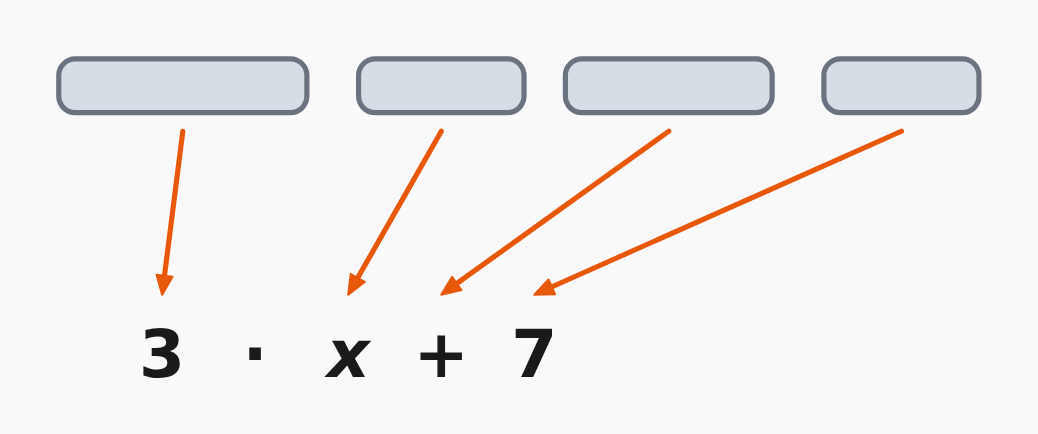
In Year 6 you start translating everyday sentences into algebra. A short phrase becomes an expression with letters and numbers.
The four basic translations
| Word phrase | Algebraic expression |
| Sum of `x` and 4 | `x + 4` |
| `x` decreased by 4 | `x − 4` |
| 4 less than `x` | `x − 4` |
| Product of `x` and 4 / 4 times `x` | `4x` |
| Quotient of `x` and 4 / `x` divided by 4 | `x ÷ 4` |
| 3 more than 5 times `x` | `5x + 3` |
Step-by-step
- Spot the operation. "Sum" / "more than" → +. "Difference" / "less than" → −. "Product" / "times" → ·. "Quotient" / "divided by" → ÷.
- Pick a variable. Use whatever letter the problem suggests; `x` is the default.
- Watch the word order. "5 less than x" is `x − 5`, not `5 − x`.
Examples
- "Twice a number, decreased by 3" → `2x − 3`.
- "Five more than the half of x" → `x ÷ 2 + 5`.
- "Three times the sum of x and 4" → `3 · (x + 4)`.
Brackets matter
Some phrases need brackets:
- "Three times the sum of x and 4" → `3 · (x + 4)` = `3x + 12`.
- "Three times x, plus 4" → `3x + 4`. Different!
Use brackets when the phrase groups an operation.
Common traps
- "Less than" / "decreased by" swaps the order. "5 less than x" = `x − 5`.
- "Times" doesn't need a `·` sign in algebra: `3x` = `3 · x`.
- A variable can stand for any number — including 0 or a negative.