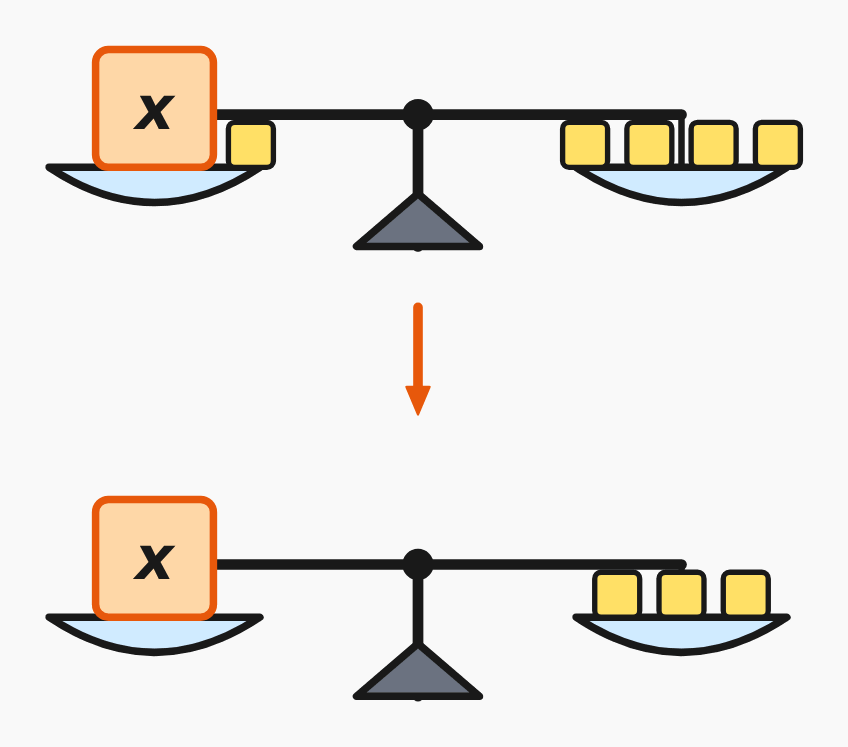
A one-step equation can be solved by doing one operation to both sides. Two cases cover everything in Year 6.
Case 1 — addition or subtraction
If `x + a = b`, then `x = b − a`.
If `x − a = b`, then `x = b + a`.
Whatever is added to x, you subtract from both sides. Whatever is subtracted from x, you add to both sides.
Example. `x + 7 = 12` → subtract 7 → `x = 5`. ✓ Check: 5 + 7 = 12. Example. `x − 4 = 9` → add 4 → `x = 13`. ✓ Check: 13 − 4 = 9.Case 2 — multiplication or division
If `a · x = b`, then `x = b ÷ a`.
If `x ÷ a = b`, then `x = b · a`.
Whatever multiplies x, you divide both sides by. Whatever divides x, you multiply both sides by.
Example. `3x = 18` → divide by 3 → `x = 6`. ✓ Check: 3·6 = 18. Example. `x ÷ 4 = 5` → multiply by 4 → `x = 20`. ✓ Check: 20 ÷ 4 = 5.Always check by substituting
Plug your answer back into the original equation. If both sides match, you're done.
Common traps
- Wrong inverse operation. Addition is undone by subtraction, not by another addition.
- Forgetting to do the operation on both sides. If you subtract from the left, you must subtract from the right too.
- Sign mistakes. `x − 4 = 9` → add 4 to both sides, not subtract.