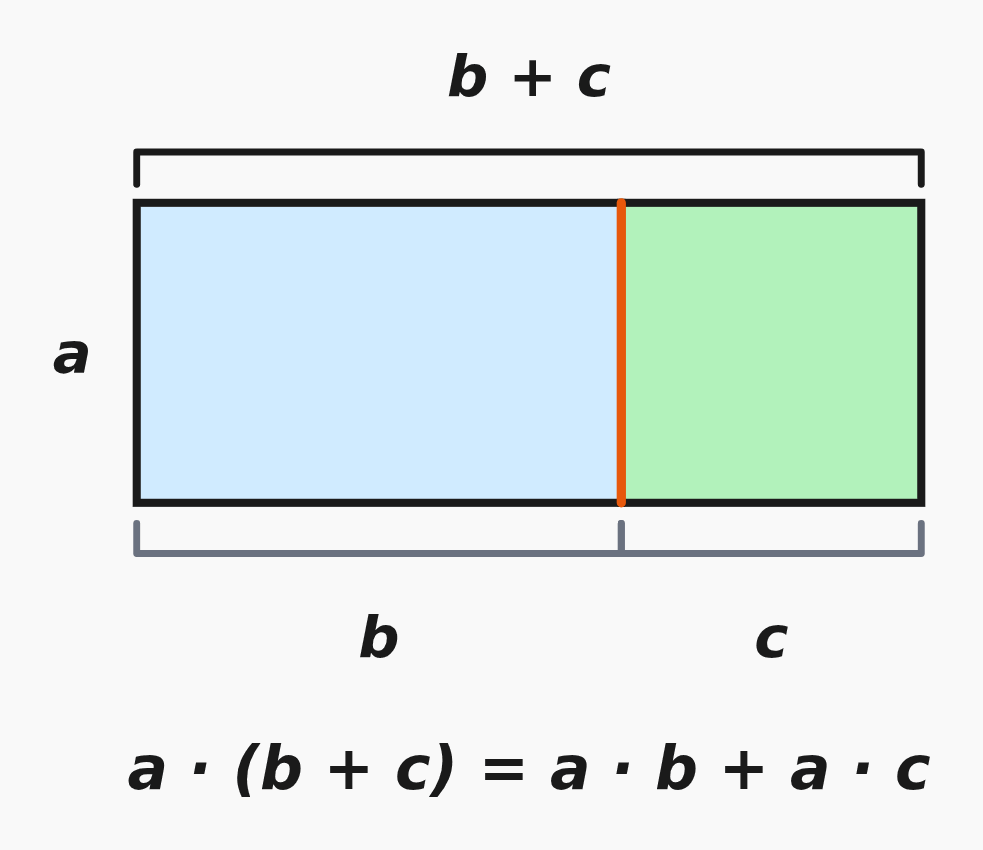
The distributive property lets you rewrite a product over a sum:
`a · (x + b) = a · x + a · b`
It works because multiplication "distributes" over addition. The same number `a` multiplies each term in the bracket.
Expanding
When you have a number times a bracket, multiply the number by each term inside.
Example. `3 · (x + 4) = 3x + 12`. Example. `5 · (n + 2) = 5n + 10`.Don't forget to multiply the second term too — that's the most common mistake.
Factoring (the reverse)
When two terms share the same factor, you can pull it out front:
Example. `3x + 12`. Both 3x and 12 are divisible by 3, so factor 3 out: `3 · (x + 4)`. Example. `5n + 10 = 5 · (n + 2)`.`a · x + a · b = a · (x + b)`
How to spot the common factor
- Look at the coefficient in front of the variable.
- Look at the constant by itself.
- Find the greatest common divisor of those two numbers — that's the factor you can pull out.
For `8x + 12` the GCD of 8 and 12 is 4, so `8x + 12 = 4 · (2x + 3)`.
Why this is useful
- It makes mental arithmetic easier: `7 · 23 = 7 · (20 + 3) = 140 + 21 = 161`.
- It turns ugly expressions into shorter ones.
- In later grades you'll use it for solving equations and simplifying algebraic fractions.