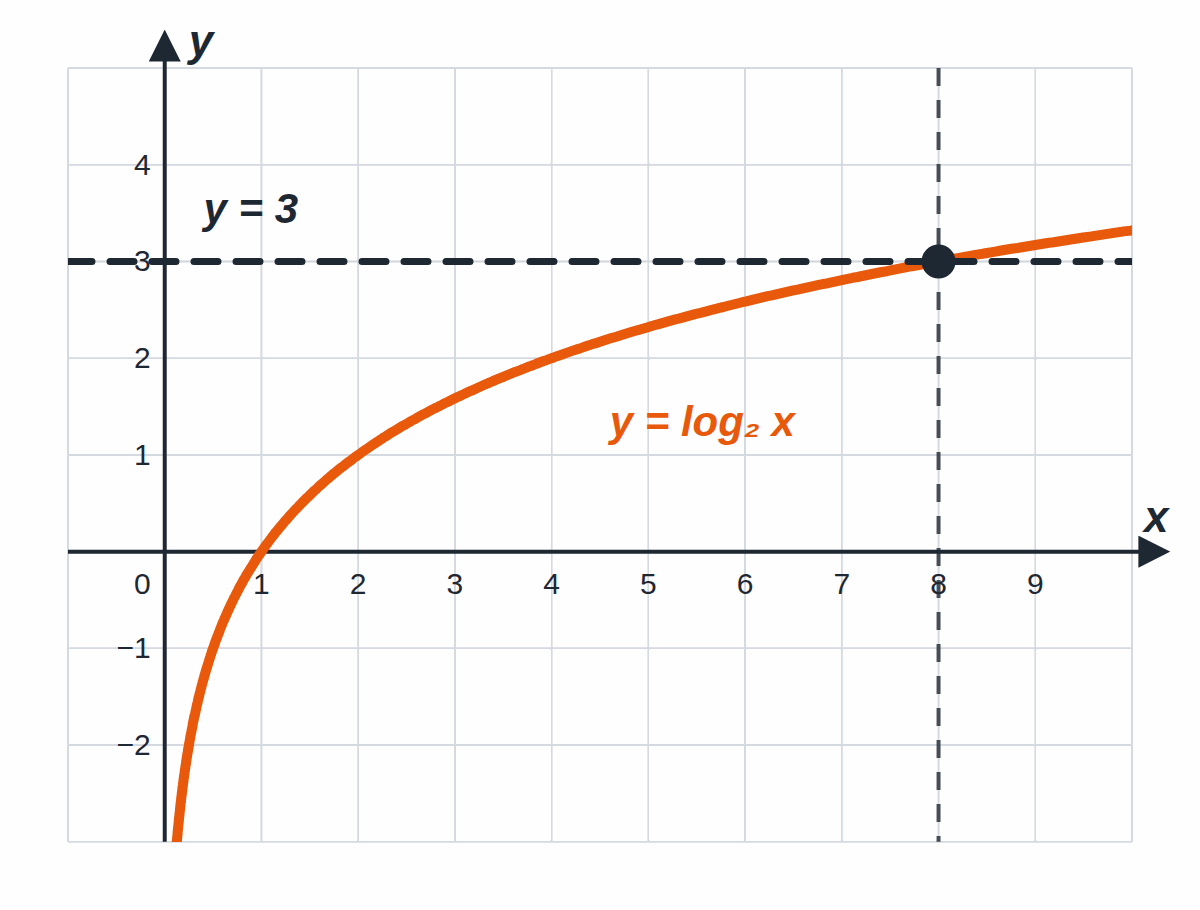
For what value of x is log₂ x = 3? A logarithm is an exponent, so we are asking: what is 2 to the power of 3? Eight. So x = 8 .
An equation with the unknown inside the argument of a logarithm is a logarithmic equation . We solve it by getting rid of the logarithm, and then we check whether the result is even allowed inside the logarithm.
Contents
The condition comes first
A logarithm exists only for a positive number. So before solving, we write down a condition : every argument of a logarithm must be greater than zero.
For log₂ (x − 3) we need x − 3 > 0, so x > 3 .
At the end we compare every root with the condition. A root that does not meet it is not a solution .
Equations from the definition
If there is a logarithm on one side and a number on the other, we use the definition: logₐ A = c means A = aᶜ.
Worked example 1
log₂ (x + 7) = 2
Condition: x + 7 > 0, so x > −7.
From the definition: x + 7 = 2² = 4.
x = −3. It meets the condition (−3 > −7).
Solution: x = −3 .
Two equal logarithms
If two logarithms with the same base are equal, their arguments are equal too: logₐ A = logₐ B means A = B.
Worked example 2
log₃ (x² − 9) = log₃ (x + 3)
Condition: x + 3 > 0 and x² − 9 > 0.
x² − 9 = x + 3, so x² − x − 12 = 0.
(x − 4)(x + 3) = 0, roots 4 and −3.
Check the condition: for x = −3 we get x + 3 = 0, and the logarithm of zero does not exist. For x = 4 we get x + 3 = 7 > 0 and x² − 9 = 7 > 0.
Solution: x = 4 .
Sums and differences of logarithms
First we combine the logarithms using the laws from the article Laws of Logarithms .
Worked example 3
log₂ x + log₂ (x + 2) = 3
Condition: x > 0 and x + 2 > 0, together x > 0.
Combine: log₂ (x(x + 2)) = 3.
From the definition: x(x + 2) = 2³ = 8, so x² + 2x − 8 = 0.
Roots: x = 2 and x = −4.
−4 does not meet the condition x > 0.
Solution: x = 2 .
Worked example 4
log₂ (x − 4) − log₂ (x − 3) = 1
Condition: x > 4.
Combine: log₂ ((x − 4)/(x − 3)) = 1, so (x − 4)/(x − 3) = 2.
x − 4 = 2x − 6, x = 2.
2 does not meet the condition x > 4.
The equation has no solution . That is a perfectly correct answer too.
Substitution
If both a logarithm and its square appear in the equation, we let t = logₐ x.
Worked example 5
(log₂ x)² − 3 · log₂ x + 2 = 0
Condition: x > 0.
Substitute t = log₂ x: t² − 3t + 2 = 0, roots t = 1 and t = 2.
log₂ x = 1 gives x = 2, log₂ x = 2 gives x = 4.
Solutions: x₁ = 2, x₂ = 4 .
💡 With this substitution t may be negative: log₂ x = −1 gives x = ½. Unlike in an exponential equation, we do not throw anything away here.
Common mistakes
A missing condition. Without it, roots for which the argument would be negative or zero stay in the answer."Splitting" a logarithm over a sum. log (x + 2) is not log x + log 2.Combining logs with different bases. log₂ x + log₃ x cannot be combined with a single law.Forgetting the answer "no solution". If all the roots drop out, the equation has no solution.
Summary
Condition: every argument of a logarithm must be positive.
logₐ A = c ⇒ A = aᶜ; logₐ A = logₐ B ⇒ A = B.
Combine sums and differences of logarithms using the laws first.
For (logₐ x)², use the substitution t = logₐ x.
At the end, check every root against the condition.
Try it yourself
log₃ (2x − 1) = 2
log₅ (x + 1) + log₅ (x − 3) = 1
log₂ (x + 1) − log₂ (x − 2) = 2
(log₁₀ x)² − log₁₀ x = 0
Answers:
2x − 1 = 9, x = 5.
(x + 1)(x − 3) = 5, x² − 2x − 8 = 0, roots 4 and −2. Condition x > 3, solution x = 4.
x + 1 = 4(x − 2), x = 3. Condition x > 2, solution x = 3.
t² − t = 0, t = 0 or t = 1, so x = 1 or x = 10.
Practice
👉 Next: Logarithmic Functions
✏️ Practise this This topic has interactive exercises. Every problem is newly generated and you see straight away whether you got it right.
Go to exercises →