How many times do you have to fold a sheet of paper to get 32 layers? Every fold doubles the number of layers, so we are looking for x such that 2ˣ = 32. By trial: 2, 4, 8, 16, 32, which is five folds. So x = 5.
An equation with the unknown in the exponent is an exponential equation. Let's see how to solve one without trial and error.
The exponential function is one-to-one: two different values of x never give the same value. So:
If two powers with the same base are equal, their exponents are equal too: aʳ = aˢ ⇒ r = s.
We read the arrow ⇒ as "implies".
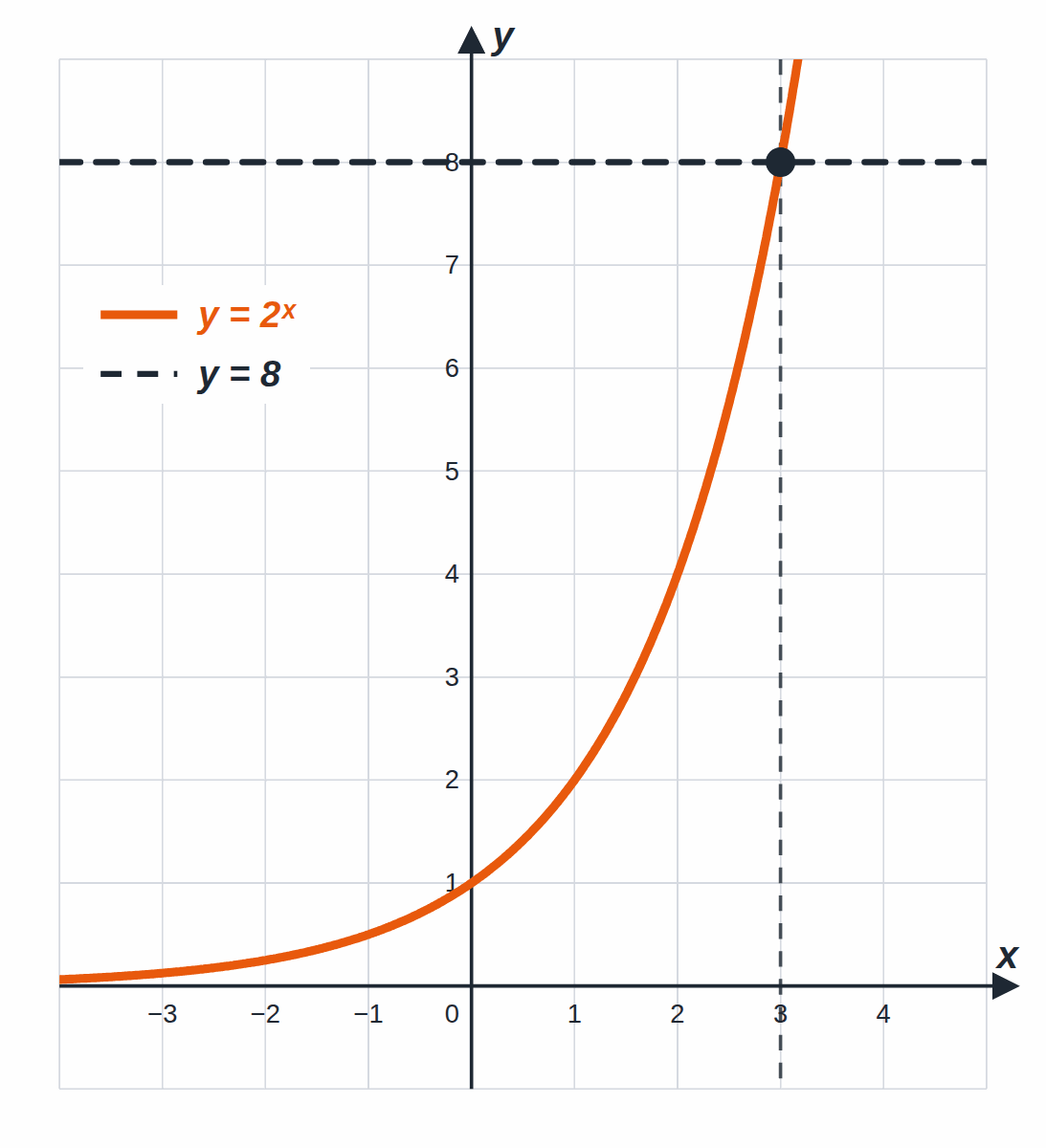
In the picture you can see the solution of the equation 2ˣ = 8 as the intersection of the graph y = 2ˣ with the line y = 8. They meet at x = 3.
Worked example 1
3^(x − 1) = 27
Write 27 as a power of three: 27 = 3³.
3^(x − 1) = 3³.
Compare the exponents: x − 1 = 3.
x = 4.
Check: 3^(4 − 1) = 3³ = 27 ✓.
Writing numbers as powers of the same base
You often need to match the bases. These rewrites help:
Number
4
8
9
27
½
¼
√2
1
As a power
2²
2³
3²
3³
2⁻¹
2⁻²
2^½
2⁰
Worked example 2
4ˣ = 8
4 = 2² and 8 = 2³, so (2²)ˣ = 2³.
Power of a power: (2²)ˣ = 2^(2x).
2x = 3, so x = 3/2.
Worked example 3
9^(x + 1) = 27ˣ
9 = 3², 27 = 3³: 3^(2(x + 1)) = 3^(3x).
2x + 2 = 3x.
x = 2.
Worked example 4
(½)ˣ = 16
½ = 2⁻¹ and 16 = 2⁴: 2^(−x) = 2⁴.
−x = 4, so x = −4.
Factoring out a power
If powers are added in the equation, you cannot compare exponents. Factoring out the common power helps.
Worked example 5
2^(x + 1) + 2ˣ = 12
2^(x + 1) = 2 · 2ˣ, so 2 · 2ˣ + 2ˣ = 12.
Factor out 2ˣ: 2ˣ · (2 + 1) = 12, so 3 · 2ˣ = 12.
2ˣ = 4 = 2², so x = 2.
Substitution
Some equations look like quadratics. Look: 4ˣ = (2²)ˣ = (2ˣ)². If we let t = 2ˣ, the equation becomes a quadratic.
Worked example 6
4ˣ − 6 · 2ˣ + 8 = 0
Substitute t = 2ˣ: t² − 6t + 8 = 0.
Roots: t₁ = 2, t₂ = 4.
Back to x: 2ˣ = 2 gives x = 1, 2ˣ = 4 gives x = 2.
Solutions: x₁ = 1, x₂ = 2.
Worked example 7
4ˣ − 3 · 2ˣ − 4 = 0
t² − 3t − 4 = 0, roots t₁ = 4, t₂ = −1.
2ˣ = 4 gives x = 2.
2ˣ = −1 has no solution: a power with a positive base is always positive.
Solution: x = 2.
When the bases cannot be matched
You cannot rewrite the equation 2ˣ = 5 with the same base, because 5 is not a power of two. You solve an equation like this with a logarithm: x = log₂ 5 ≈ 2.32. More in the article Logarithms.
Common mistakes
Comparing exponents when the bases are different. 4ˣ = 8 does not give x = 8 or x = 2. Match the bases first.
A forgotten bracket. 9^(x + 1) = 3^(2(x + 1)) = 3^(2x + 2), not 3^(2x + 1).
Adding exponents in a sum. 2^(x + 1) + 2ˣ is not 2^(2x + 1). Exponents are added when you multiply powers, not when you add them.
Keeping a negative t. With the substitution t = 2ˣ, t must be positive.
Summary
An exponential equation has the unknown in the exponent.
Write both sides as powers with the same base and compare the exponents.
Solve a sum of powers by factoring out the common power.
Solve an equation like 4ˣ − 6 · 2ˣ + 8 = 0 with the substitution t = 2ˣ; throw away any negative t.
If the bases cannot be matched, a logarithm helps.
Try it yourself
5^(2x − 1) = 125
8ˣ = 4
3^(x + 2) − 3ˣ = 72
9ˣ − 4 · 3ˣ + 3 = 0
Answers:
125 = 5³, 2x − 1 = 3, x = 2.
2^(3x) = 2², 3x = 2, x = 2/3.
3ˣ · (9 − 1) = 72, 3ˣ = 9, x = 2.
t = 3ˣ: t² − 4t + 3 = 0, t = 1 or t = 3, so x = 0 or x = 1.