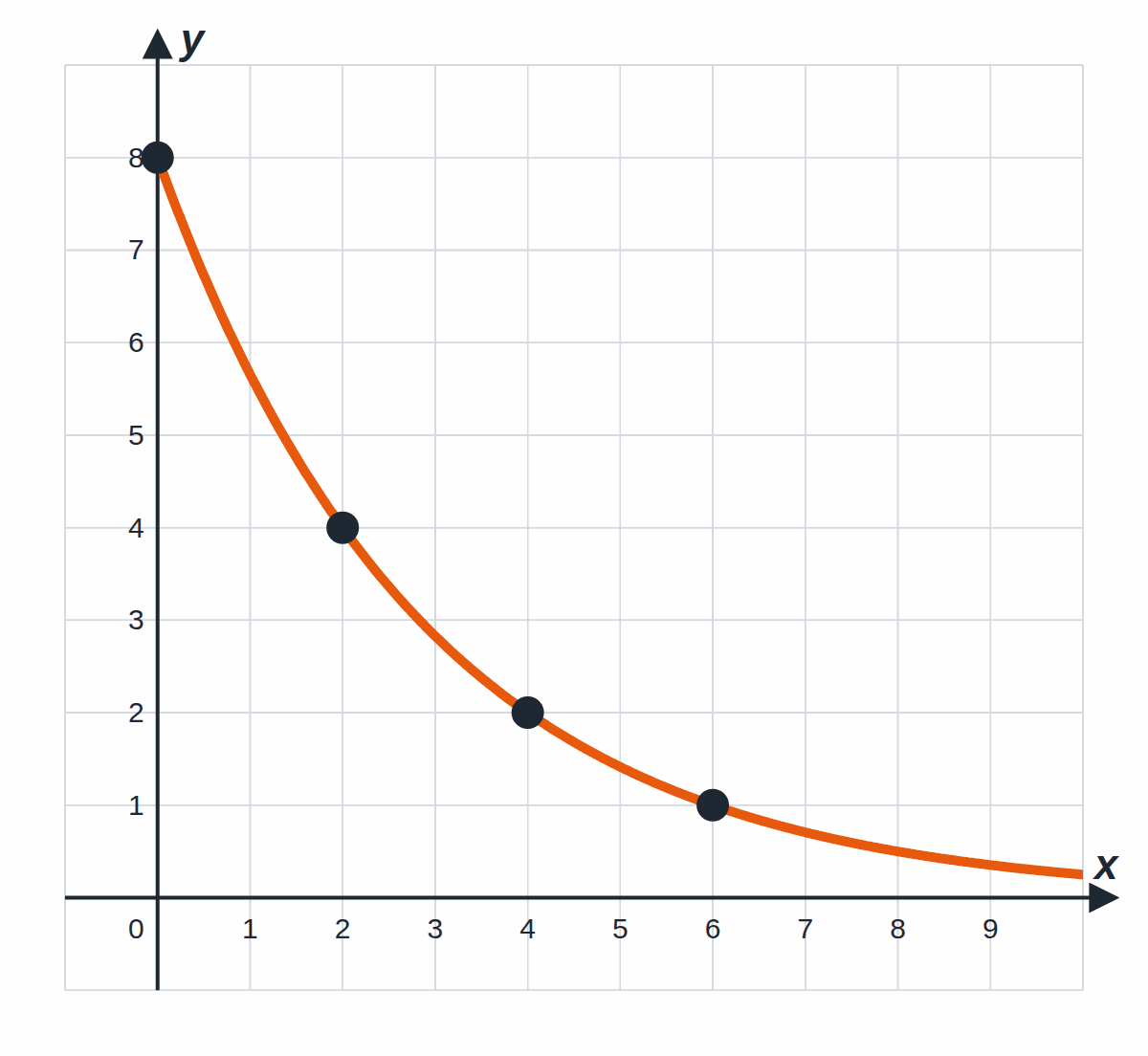
You put 1,000 dollars in the bank at 5% interest per year. After one year you have 1,050 dollars. In the second year, though, the bank works out 5% of 1,050 dollars, not of 1,000 dollars. You earn interest on your interest too, so the amount grows faster and faster.
This is exponential growth: in the same amount of time the quantity is always multiplied by the same number. For decay, that number is less than 1.
If a quantity starts with the value N₀ (read "N nought") and is multiplied by the number q in each period, then after n periods its value is
N = N₀ · qⁿ
The number q is called the growth factor (or multiplier):
growth of p% per period: q = 1 + p/100, for example growth of 5% gives q = 1.05,
decrease of p% per period: q = 1 − p/100, for example a decrease of 15% gives q = 0.85,
doubling: q = 2, halving: q = ½.
This is really an exponential function, which you can read about in the article Exponential Functions: the variable n is in the exponent.
Compound interest
Worked example 1
You deposit 2,000 dollars in an account with an annual interest rate of 3%. Interest is added once a year. How many dollars will be in the account after 4 years (ignore tax)?
Starting amount: N₀ = 2,000.
Growth factor: q = 1 + 3/100 = 1.03.
Number of years: n = 4.
N = 2,000 · 1.03⁴ ≈ 2,000 · 1.1255 ≈ 2,251.02.
After 4 years there will be about 2,251 dollars in the account.
💡 Round only at the end. If you round 1.03⁴ to 1.13, you get 2,260 dollars, which is 9 dollars too much.
Decrease by a percentage
Worked example 2
A car costs 20,000 dollars. Every year it loses 15% of its value from the previous year. What will it be worth after 3 years?
After 3 years the car will be worth about 12,283 dollars.
⚠️ Careful: after 3 years it has not lost 3 · 15% = 45%. It has lost only about 38.6%, because each year the 15% is taken from a smaller amount.
Half-life
Radioactive substances decay. The half-life T is the time it takes for half of the substance to decay. After one half-life ½ is left, after two ¼, after three ⅛.
If a time t has passed, then t/T half-lives have passed, and so
m = m₀ · (½)^(t/T)
Worked example 3
An isotope of iodine has a half-life of 8 days. We have 640 g. How much is left after 24 days?
Number of half-lives: 24 / 8 = 3.
m = 640 · (½)³ = 640 / 8 = 80 g.
The formula also works when t/T is not a whole number. After 12 days, 640 · (½)^1.5 ≈ 226.3 g is left.
Finding the time or the percentage
How many years?
After how many whole years will a deposit double for the first time at 4% interest?
We want 1.04ⁿ ≥ 2.
The unknown is in the exponent. A logarithm helps (more in the article Logarithms): n ≥ log 2 / log 1.04 ≈ 17.67.
Whole years: n = 18. After 17 years the deposit has not doubled yet.
What percentage per year?
A town had 40,000 inhabitants, and 5 years later it had 46,000. What was the constant yearly growth rate?
40,000 · q⁵ = 46,000, so q⁵ = 1.15.
q is the fifth root of 1.15: q ≈ 1.0284.
The yearly growth is about 2.8%.
Common mistakes
Adding percentages. Growth of 5% a year for 10 years is not growth of 50%. It is 1.05¹⁰ ≈ 1.63, so about 63%.
The wrong factor for a decrease. A decrease of 20% means multiplying by 0.8, not by 0.2.
Rounding in the middle of the calculation. Raise the growth factor to the power exactly and round only the result.
Whole years. If you get n ≈ 17.67 and the question asks "after how many whole years", the answer is 18, not 17.
Summary
Exponential growth and decay: N = N₀ · qⁿ.
Growth of p%: q = 1 + p/100. Decrease of p%: q = 1 − p/100.
Half-life T: m = m₀ · (½)^(t/T).
You find an unknown time with a logarithm and an unknown growth factor with a root.
Try it yourself
There are 300 bacteria and their number doubles every hour. How many will there be after 5 hours?
An account holds 5,000 dollars at 2% interest per year. How much will be in the account after 3 years? Round to the nearest dollar.
A substance has a half-life of 10 years. What fraction is left after 30 years?