
Fold a sheet of paper in half, drop some ink on it and unfold it again. You get a picture whose left half is the mirror image of the right half. Some graphs of functions look exactly like that — they are symmetric about the y-axis. We call such functions even. Other graphs land exactly on themselves when you turn them half a turn around the point (0, 0). Those are odd functions.
Contents
- Even functions
- Odd functions
- How to check by calculation
- Neither even nor odd
- Watch the domain
- Common mistakes
- Summary
- Try it yourself
- Practice
Even functions
Take f(x) = x². Substitute 3 and −3:
- f(3) = 3² = 9,
- f(−3) = (−3)² = 9.
Opposite numbers gave the same value. This works for every x, because squaring "eats" the sign.
A function f is even if for every x in its domain:
f(−x) = f(x) — read "f of minus x equals f of x".
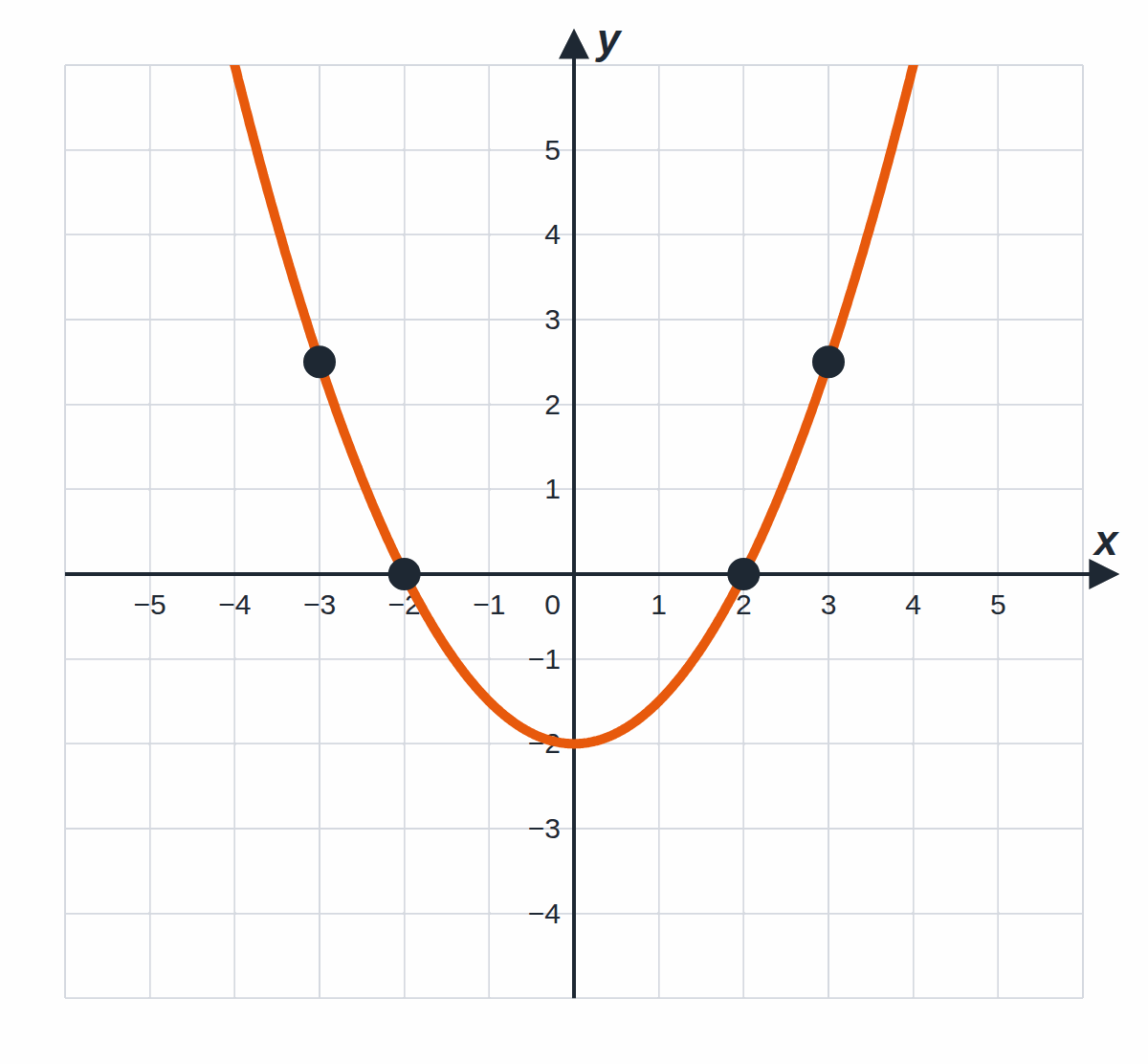
The graph of an even function is symmetric about the y-axis. A point (a, b) on the graph always has a "twin" (−a, b).
Examples of even functions: x², x⁴, |x|, x² − 5, 3/(x² + 1).
Odd functions
Take f(x) = x³:
- f(2) = 2³ = 8,
- f(−2) = (−2)³ = −8.
Opposite numbers gave opposite values.
A function f is odd if for every x in its domain:
f(−x) = −f(x) — read "f of minus x equals minus f of x".
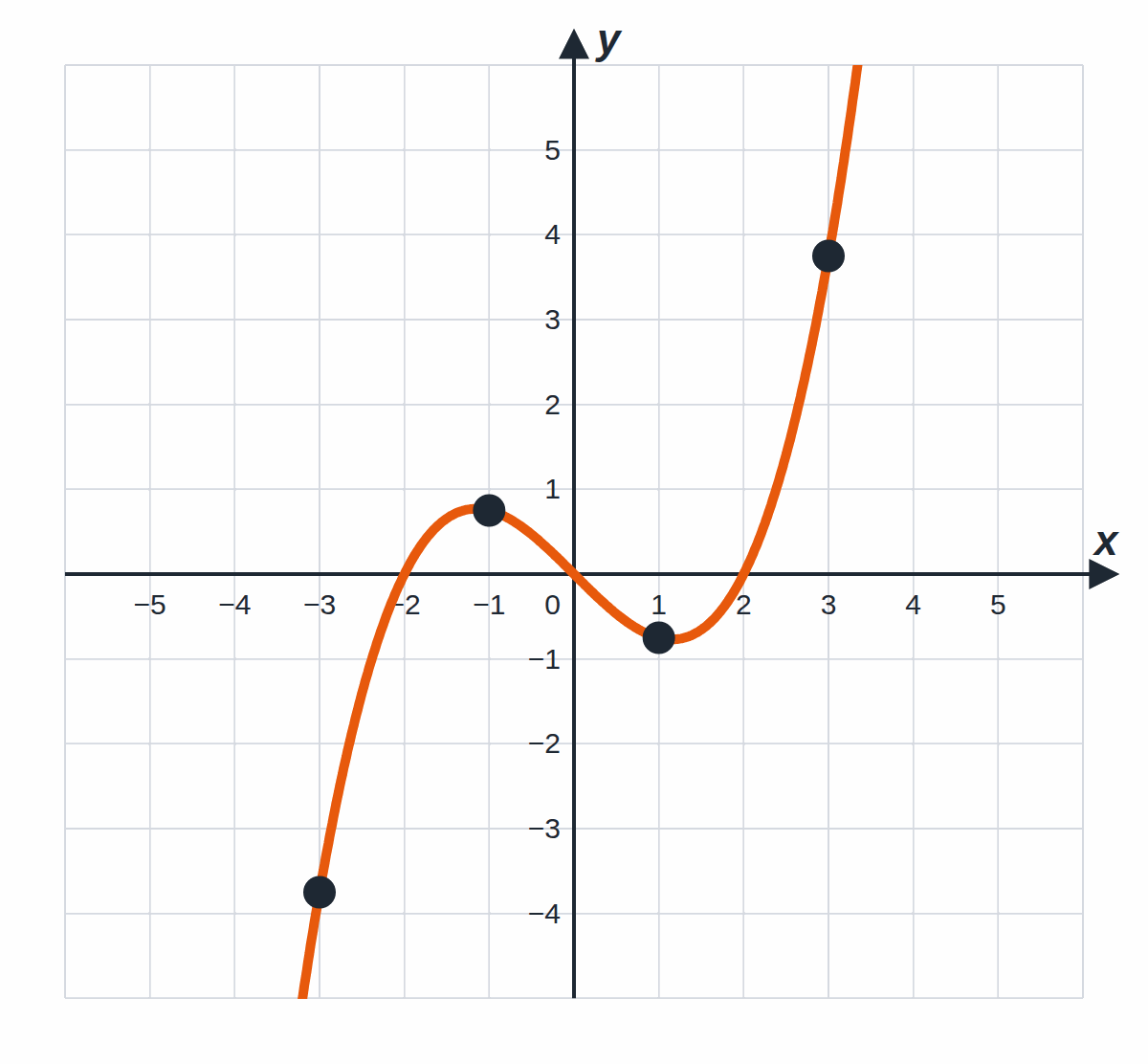
The graph of an odd function is symmetric about the origin (0, 0). A point (a, b) has a "twin" (−a, −b).
Examples of odd functions: x, x³, x⁵, 1/x, x³ − 4x.
💡 The names are not random: x² and x⁴ have an even exponent and are even functions; x and x³ have an odd exponent and are odd functions.
How to check by calculation
The method has three steps:
- Check that the domain is symmetric about zero (whenever it contains x, it also contains −x).
- Substitute −x for x in the formula and simplify.
- Compare the result with f(x) and with −f(x).
Worked example 1
f(x) = x⁴ − 3x².
- The domain is ℝ, which is symmetric.
- f(−x) = (−x)⁴ − 3(−x)² = x⁴ − 3x².
- We got the original formula: f(−x) = f(x). The function is even.