On holiday abroad you convert prices: from pounds to euros you multiply by the exchange rate, and from euros back to pounds you divide by it. The second conversion does exactly the opposite job of the first. Such a "return" function is called an inverse function.
If a function f turns the number 3 into the number 7, the inverse function f⁻¹ turns 7 back into 3.
We read f⁻¹ as "f inverse" or "the inverse of f". Careful, it is not a power: f⁻¹(x) is not 1/f(x).
An inverse function must be able to "send back" a result in exactly one way. With y = x² that is impossible: we get the value 9 from 3 and also from −3. If we asked "where did 9 come from?", there would be no single answer.
A function is one-to-one if two different numbers x never give the same value y. Only a one-to-one function has an inverse function.
One-to-one: for example y = 2x + 1, y = x³, y = 1/x, y = √x.
Not one-to-one: y = x², y = |x|, y = 5 (a constant).
💡 From the graph: if some horizontal line crosses the graph at least twice, the function is not one-to-one. More in the article Function Properties.
💡 A function that is not one-to-one can be "restricted". y = x² for x ≥ 0 is one-to-one — its inverse function is y = √x.
How to find the inverse function
Method:
Write y = f(x).
Swap x and y.
Make y the subject.
Worked example 1
f(x) = 2x + 1.
y = 2x + 1.
Swap: x = 2y + 1.
Make y the subject: 2y = x − 1, so y = (x − 1)/2.
Result: f⁻¹(x) = (x − 1)/2.
Check: f(3) = 7 and f⁻¹(7) = (7 − 1)/2 = 3. ✓
Worked example 2
f(x) = x−34−1.
Swap: x = y−34−1.
x + 1 = y−34, so y − 3 = x+14.
y = x+14+3.
Result: f⁻¹(x) = 4/(x + 1) + 3. The asymptotes have swapped: f has x = 3 and y = −1, f⁻¹ has x = −1 and y = 3.
The graph of the inverse function
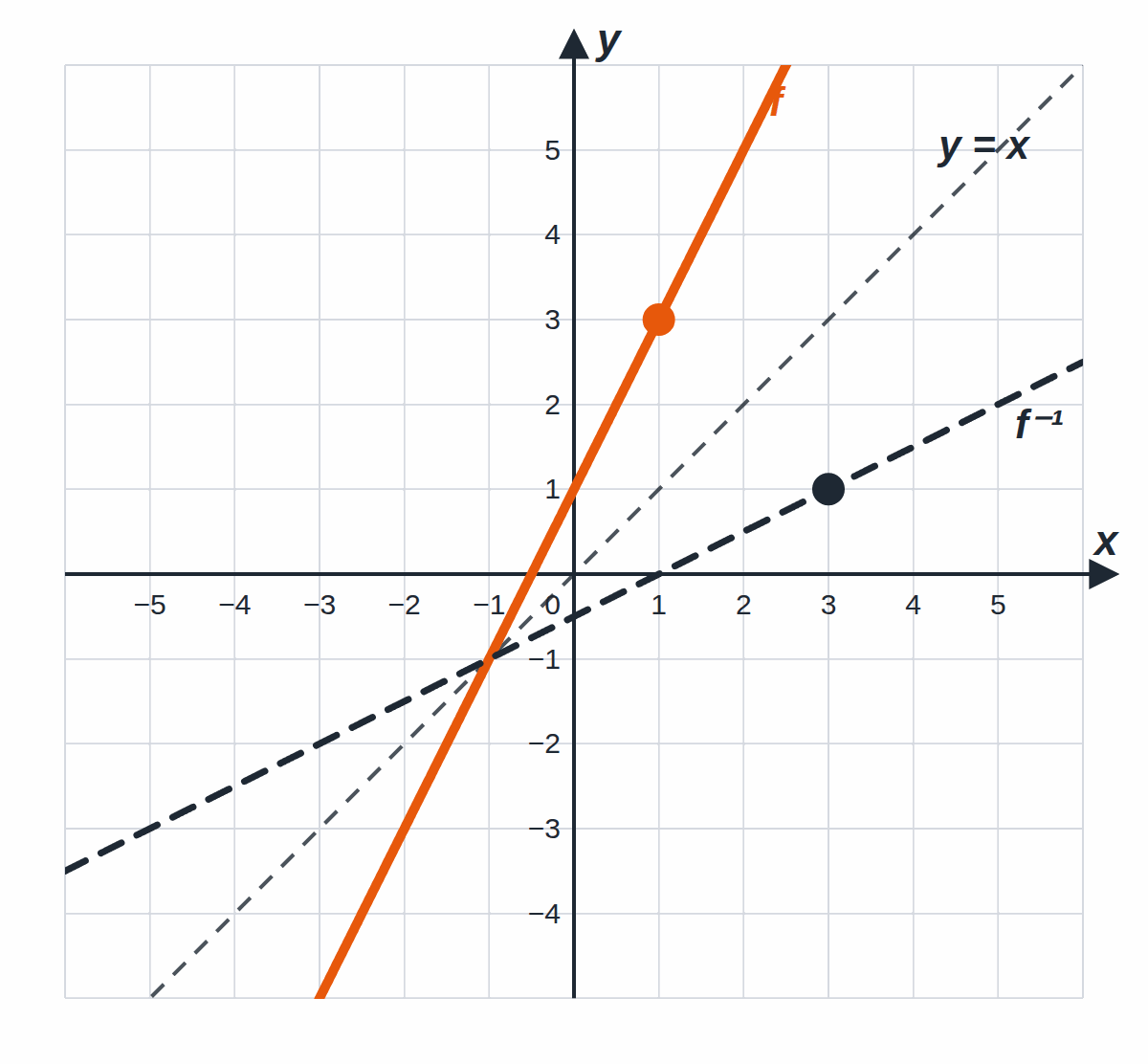
If the point (a, b) lies on the graph of f, then f sends a to b. The inverse function sends b to a, so the point (b, a) lies on the graph of f⁻¹. The coordinates simply swap.
Swapping the coordinates is a reflection in the line y = x. So:
The graphs of f and f⁻¹ are symmetric about the line y = x.
In the picture: the point (1, 3) on the graph of f has the mirror image (3, 1) on the graph of f⁻¹.
Domain and range
When x and y swap, the domain and the range swap too:
the domain of f⁻¹ = the range of f,
the range of f⁻¹ = the domain of f.
For f(x) = 4/(x − 3) − 1 the domain is ℝ ∖ {3} and the range is ℝ ∖ {−1}. For the inverse function the domain is ℝ ∖ {−1} and the range is ℝ ∖ {3}.
Common mistakes
f⁻¹(x) = 1/f(x). No! The minus one here does not mean the reciprocal. For f(x) = 2x + 1, 1/f(x) = 1/(2x + 1), but f⁻¹(x) = (x − 1)/2.
"Reversed" operations in the wrong order. f(x) = 2x + 1 first multiplies by 2 and then adds 1. The inverse function must first subtract 1 and only then divide by 2: (x − 1)/2, not x/2 − 1.
An inverse of a function that is not one-to-one. y = x² on the whole of ℝ has no inverse function.
Reflecting in the y-axis. The graphs of f and f⁻¹ are symmetric about the line y = x, not about an axis.
Summary
The inverse function f⁻¹ sends the result of f back: if f(a) = b, then f⁻¹(b) = a.
It exists only for a one-to-one function.
To find it: y = f(x), swap x and y, make y the subject.
The graph of f⁻¹ is the mirror image of the graph of f in the line y = x.
The domain of f⁻¹ is the range of f, and the range of f⁻¹ is the domain of f.
Try it yourself
Find the inverse function of f(x) = 3x − 6.
Find the inverse function of f(x) = 2/(x + 1).
The point (−2, 5) lies on the graph of f. Which point lies on the graph of f⁻¹?
Does the function y = |x| have an inverse function?