Article Contents
- Three Possibilities
- One Solution
- No Solution
- Infinite Solutions
- How to Identify Each Case
- Interactive Exercises
1. Three Possibilities {#three-possibilities}
When solving a linear equation, exactly one of these happens:
| Case | What it Means |
| One Solution | The equation has exactly one answer |
| No Solution | The equation has no answer at all |
| Infinite Solutions | Any number works as an answer |
2. One Solution {#one-solution}
This is the "normal" case.
General Form: whereExample
Solve:
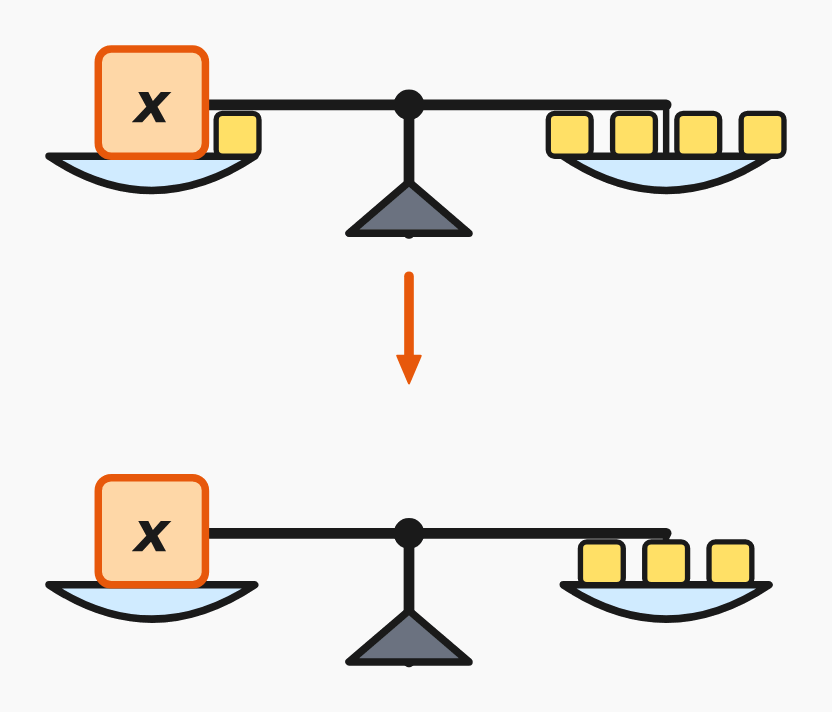
Step 1: 2x = 11 - 3 = 8
Step 2: x = 8/2 = 4
The equation has exactly one solution: .
3. No Solution {#no-solution}
This happens when solving leads to a false statement.
General Form: whereExample
Solve:
Step 1: Subtract x from both sides
        x - x + 2 = x - x + 5
Step 2: Simplify
        2 = 5  ❌ FALSE!
This equation has no solution.
Why?
The left side will always be 2 more than the right side, no matter what is.
4. Infinite Solutions {#infinite-solutions}
This happens when solving leads to a true statement.
General Form:Example
Solve:
Step 1: Expand right side
        2x + 4 = 2x + 4
Step 2: Subtract 2x from both sides
        4 = 4  ✓ TRUE!
This equation has infinitely many solutions (any works).
Why?
always equals , no matter what is.5. How to Identify Each Case {#how-to-identify-each-case}
After simplifying, look at what's left:
| Simplified Form | Number of Solutions |
| One solution | |
| No solution | |
| Infinite solutions |
Quick Reference
Equation looks like...     Result:
x = 5                       ONE SOLUTION
3 = 7                       NO SOLUTION
8 = 8                       INFINITE SOLUTIONS
Interactive Exercises
- Counting Solutions - Practice identifying the number of solutions
Related Articles
- Comprehensive Guide - Full solving techniques
- Simple Equations - Basic solving