Article Contents
- What is a Linear Equation?
- The Balance Principle
- Basic Equivalent Transformations
- Step-by-Step Solving Process
- Types of Linear Equations
- Special Cases: Number of Solutions
- Common Mistakes to Avoid
- Interactive Exercises
1. What is a Linear Equation? {#what-is-a-linear-equation}
A linear equation with one unknown is an equation that can be written in the form:
where:
- , , and are known numbers (coefficients)
- is the unknown we want to find
- The highest power of is 1 (that's why it's "linear")
Examples of Linear Equations
| Equation | |||
| 2 | 3 | 11 | |
| 1 | -5 | 8 | |
| 3 | 0 | 15 | |
| 0 | 6 |
Not Linear Equations (Why?)
- — has power 2 (quadratic)
- — is in the exponent (exponential)
- — is in the denominator (rational)
2. The Balance Principle {#the-balance-principle}
The key to solving equations is the balance principle:
Whatever you do to one side of the equation, you must do to the other side.
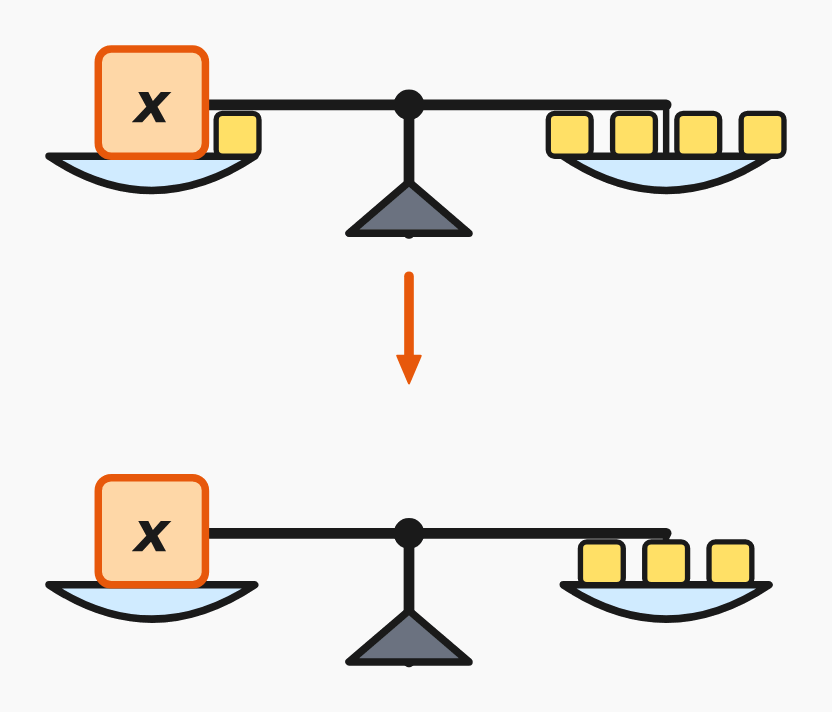
Think of an old-fashioned balance scale:
[LEFT] = [RIGHT]If you add 3 to the left side, you must add 3 to the right side to keep it balanced.
Visual Example
Starting equation:
Step 1:     x + 2 = 7
            [  7  ]
Step 2:     x + 2 - 2 = 7 - 2    (subtract 2 from both sides)
            [  5  ]
Step 3:     x = 5                (solution!)
3. Basic Equivalent Transformations {#basic-equivalent-transformations}
These are the allowed operations that keep equations equivalent:
Addition and Subtraction
Multiplication and Division
Moving Terms
When a term moves from one side to the other, it changes sign:
4. Step-by-Step Solving Process {#step-by-step-solving-process}
Example 1: Simple Equation
Solve:
Step 1: Identify what needs to be removed from the left side- is alone, but 4 is added to it
- Remember: what we do to one side, we do to the other
Example 2: Equation with Negative Terms
Solve:
Step 1: -7 is on the left, so we add 7 to both sidesExample 3: Equation with Coefficient
Solve:
Step 1: 3 is multiplied by , so we divide both sides by 35. Types of Linear Equations {#types-of-linear-equations}
Type 1: (Unknown added to a number)
Example:
Type 2: (Unknown minus a number)
Example:
Type 3: (Unknown multiplied by a number)
Example:
Type 4: (Unknown divided by a number)
Example:
Type 5: Unknown on Both Sides
Solve:
Step 1: Move terms to one side (subtract from both sides)6. Special Cases: Number of Solutions {#special-cases-number-of-solutions}
Case 1: One Solution
Most equations have exactly one solution.
Example:
Case 2: No Solution (Contradiction)
When solving leads to a false statement.
Example:
Subtract from both sides:
This equation has no solution.
Case 3: Infinite Solutions (Identity)
When solving leads to a true statement.
Example:
Expand right side:
Subtract from both sides:
This equation has infinitely many solutions (any works).
7. Common Mistakes to Avoid {#common-mistakes-to-avoid}
❌ Mistake 1: Not Doing the Same Thing to Both Sides
❌ Mistake 2: Forgetting Negative Signs
❌ Mistake 3: Incorrect Fraction Handling
❌ Mistake 4: Sign Errors When Moving Terms
Summary of Formulas
| Equation Type | Solution Method |
| Collect terms, then solve |
| Number of Solutions | Condition |
| One solution | in |
| No solution | where |
| Infinite solutions |
Interactive Exercises
Practice what you've learned with our interactive exercises:
- Linear Equations - Basic - Simple equations
- One-step equations with addition - First add two numbers on one side
- Linear Equations - Both Sides - Unknown on both sides
- Linear Equations - Fractions - Equations with fractions
- Linear Equations - Special Cases - One, no, or infinite solutions
Related Articles
- Equivalent Equations - Learn about equivalent transformations
- Equations with Fractions - Fractions and unknowns