Article Contents
- What are Equivalent Equations?
- Rules for Creating Equivalent Equations
- Visual Examples
- Practice Problems
- Interactive Exercises
1. What are Equivalent Equations? {#what-are-equivalent-equations}
Equivalent equations are equations that have the same solution(s).If makes equation A true, and also makes equation B true, then A and B are equivalent.
Example
These three equations are all equivalent (they all have as their solution):
| Equation | Verification |
2. Rules for Creating Equivalent Equations {#rules-for-creating-equivalent-equations}
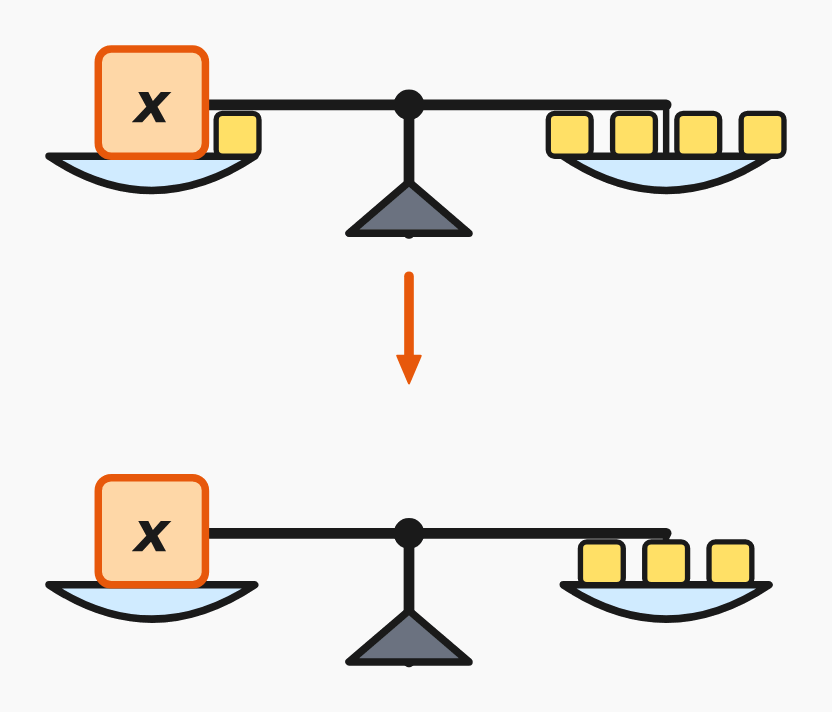
The balance principle gives us these rules:
Rule 1: Add the Same Number to Both Sides
Rule 2: Subtract the Same Number from Both Sides
Rule 3: Multiply Both Sides by the Same Number
Rule 4: Divide Both Sides by the Same Number (non-zero)
Rule 5: Swap Sides (Reflexive Property)
3. Visual Examples {#visual-examples}
Transformation Chain
Starting with:
Step 1: x + 4 = 12
Step 2: x = 12 - 4    (subtract 4 from both sides)
Step 3: x = 8         (calculate)
Each step produces an equivalent equation.
Multiple Transformations
Starting with:
Step 1: 2x + 3 = 11
Step 2: 2x = 11 - 3      (subtract 3 from both sides)
Step 3: 2x = 8           (calculate)
Step 4: x = 8/2          (divide both sides by 2)
Step 5: x = 4            (calculate)
All equations in this chain are equivalent!
4. Practice Problems {#practice-problems}
Problem 1
Which equation is equivalent to ?
- A)
- B)
- C)
- D)
Problem 2
Which transformation of gives an equivalent equation?
- A) Add 3 to both sides
- B) Subtract 3 from both sides
- C) Divide both sides by 3
- D) Multiply both sides by 3
5. Interactive Exercises {#interactive-exercises}
Test your understanding of equivalent equations:
- Equivalent Equations Quiz - Multiple choice identification
Related Articles
- Comprehensive Guide - Full solving process
- Simple Equations - Basic solving techniques