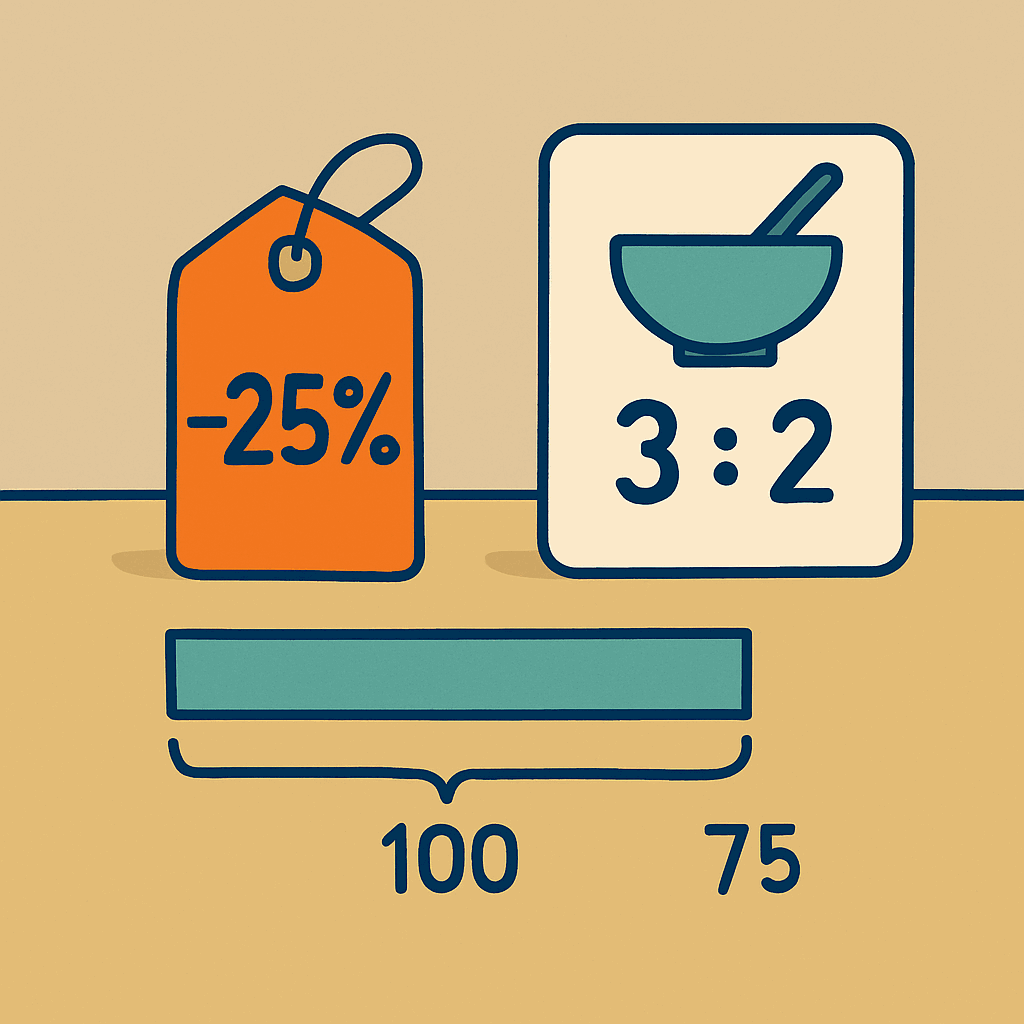
Both percentages and ratios describe the relationship between parts and a whole. So problems from both areas follow very similar steps.
Percent — discount
Problem. A bicycle cost £300. It's on sale at 25 % off. How much does it cost now? Working:- Discount in £: `300 × 25 ÷ 100 = £75`.
- New price: `300 − 75 = £225`.
Or directly: new price = `300 × 75 ÷ 100 = £225` (since you pay 75 % of the original).
Percent — whole from a part
Problem. A club has 12 children, which is 20 % of the whole year group. How many are in the year group? Working:- Whole = `(part × 100) ÷ percent` = `(12 × 100) ÷ 20 = 60 children`.
Alternative: 20 % = 1/5. If 12 is a fifth, the whole is 12 × 5 = 60.
Ratio — sharing
Problem. Mia and Jamie share 42 sweets in the ratio 3 : 4. How many does each get? Working:- Total parts: `3 + 4 = 7`.
- One part: `42 ÷ 7 = 6 sweets`.
- Mia: `3 × 6 = 18`. Jamie: `4 × 6 = 24`.
Check: 18 + 24 = 42 ✓.
Ratio — recipe
Problem. A recipe for 4 people needs 200 g of flour. How much flour for 10 people? Working (rule of three):- `200 × 10 ÷ 4 = 500 g`.
Common traps
- "20 % off" means new price = 80 %, not 20 %. Watch what's being asked.
- "In the ratio 3 : 4" is always split into 3 + 4 = 7 parts, not 3 or 4 alone.
- From part to whole — multiply, not divide (this is where most slips happen).