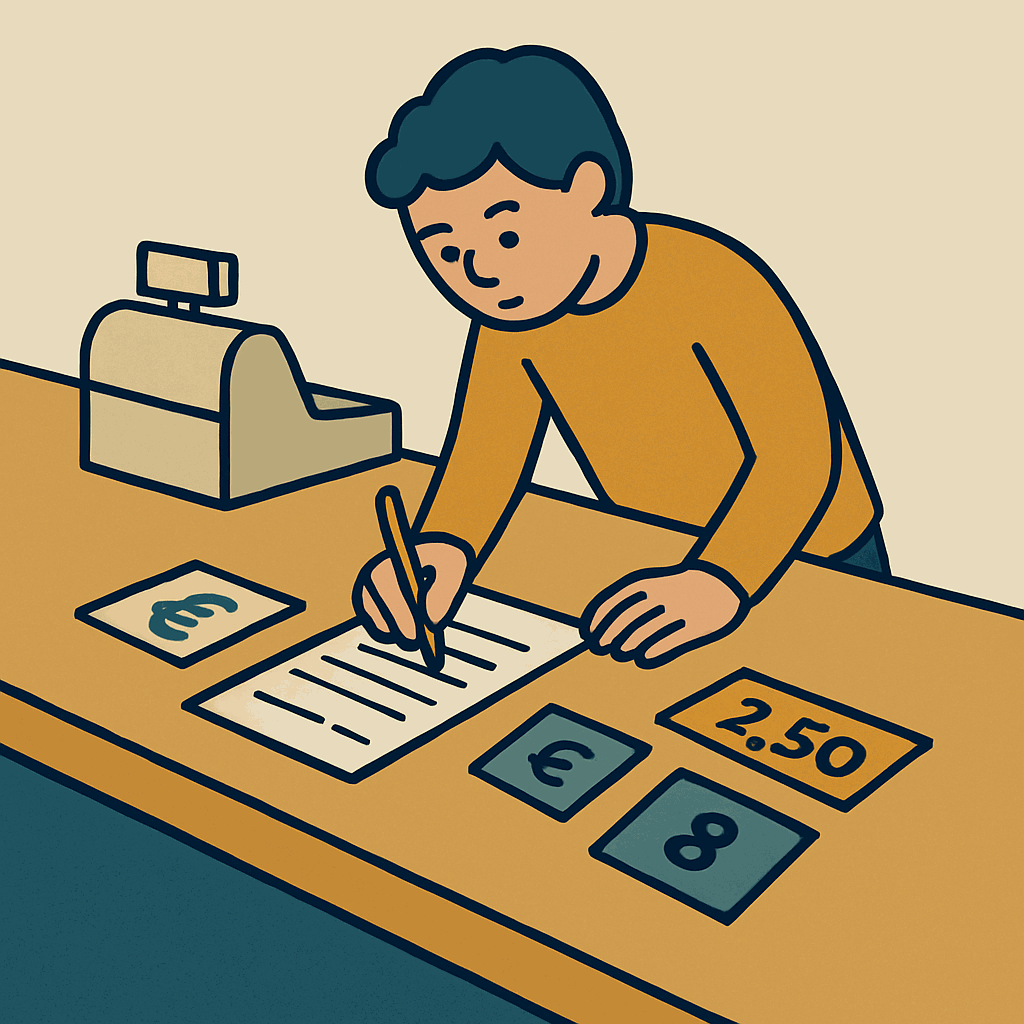
The most common place you'll meet decimals in real life is money. In pounds the hundredth is a penny: £1 = 100 p. So decimal word problems are nearly always about shopping.
Type 1: price × quantity
Problem. One notebook costs £1.20. How much for 6 notebooks? Working:- Multiply: `1.20 × 6 = £7.20`.
Trick: £1.20 = £1 + 20 p. Six times that is £6 + 120 p = £6 + £1.20 = £7.20.
Type 2: unit price
Problem. 5 kg of apples cost £12.50. How much for 1 kg? Working:- Divide: `12.50 ÷ 5 = £2.50/kg`.
Check: `2.50 × 5 = 12.50` ✓.
Type 3: change / remainder
Problem. The bill was £23.40. Mia paid £50. How much change? Working:- Difference: `50.00 − 23.40 = £26.60`.
Trick: count up "to the nearest whole": from 23.40 to 24.00 is 0.60. From 24 to 50 is 26. Total 26.60.
Type 4: mixed shopping
Problem. Mia bought 3 apples at £0.40 each and 2 bananas at £0.55 each. How much did she pay? Working:- Apples: `3 × 0.40 = £1.20`.
- Bananas: `2 × 0.55 = £1.10`.
- Total: `1.20 + 1.10 = £2.30`.
Common traps
- Mind the decimal point. £12.5 and £1.25 are not the same.
- Pounds and pence. It's written £2.30, not £2.3 or £2.03.
- When dividing, always check the unit price is reasonable.