Number of Solutions and Quadratic Equations with a Parameter
Sometimes you don't need the solutions themselves, only how many there are. Does the equation x² − 4x + 5 = 0 have a solution? You don't have to solve it fully. The discriminant is enough: D = 16 − 20 = −4. It is negative, so the equation has no real solutions. Done in a few seconds.
The same idea helps with equations that contain another letter as well as x: a parameter.
For the equation ax² + bx + c = 0, work out D = b² − 4ac:
Discriminant
Number of real solutions
D > 0
two different solutions
D = 0
one solution (a repeated root)
D < 0
no real solutions
Worked example 1
How many solutions does the equation 2x² − 3x − 4 = 0 have?
D = (−3)² − 4 · 2 · (−4) = 9 + 32 = 41 > 0. The equation has two solutions.
💡 If a and c have opposite signs (like 2 and −4 here), the product −4ac is positive, so D is definitely positive. An equation like this always has two solutions.
Worked example 2
How many solutions does the equation 4x² − 12x + 9 = 0 have?
D = (−12)² − 4 · 4 · 9 = 144 − 144 = 0. The equation has one solution. Indeed: 4x² − 12x + 9 = (2x − 3)², and the solution is x = 3/2.
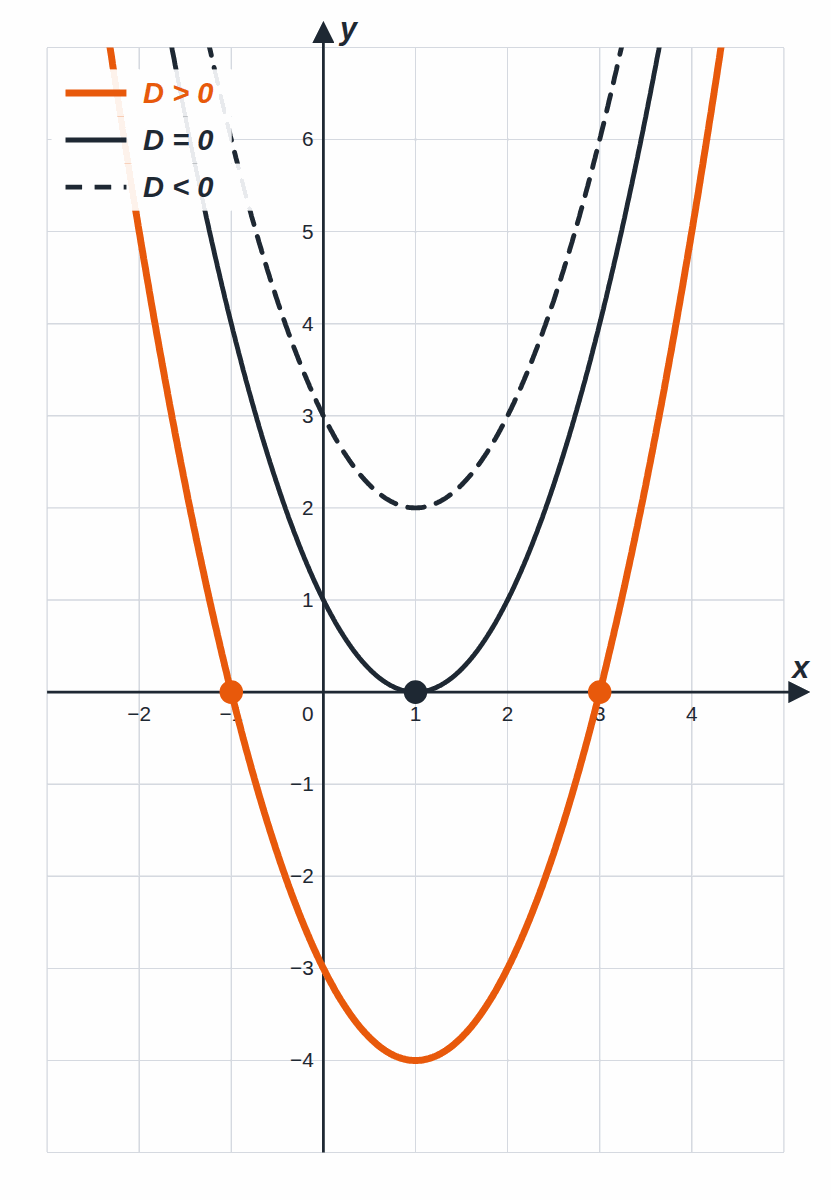
What it means on the graph
The solutions of the equation ax² + bx + c = 0 are the points where the graph of the function y = ax² + bx + c (a parabola) crosses the x-axis.
D > 0: the parabola crosses the x-axis at two points.
D = 0: the parabola just touches the x-axis with its vertex.
D < 0: the parabola lies completely above the x-axis (or completely below it).
What is a parameter
In the equation x² + mx + 9 = 0, the unknown is x and the letter m is a parameter: a number we don't know yet. You can put any number in place of m and you get a specific equation:
m = 10: x² + 10x + 9 = 0, D = 100 − 36 = 64 > 0, two solutions,
m = 6: x² + 6x + 9 = 0, D = 36 − 36 = 0, one solution,
m = 2: x² + 2x + 9 = 0, D = 4 − 36 = −32 < 0, no real solutions.
The question is: for which values of m does the equation have a given number of solutions? Work out the discriminant with the letter m in it, then solve the condition.
When does the equation have a repeated root
A repeated root means D = 0.
Worked example 3
For which values of m does the equation x² + mx + 9 = 0 have a repeated root?
a = 1, b = m, c = 9.
D = m² − 4 · 1 · 9 = m² − 36.
D = 0: m² − 36 = 0, m² = 36.
m = 6 or m = −6.
Check for m = 6: x² + 6x + 9 = (x + 3)², the only root is x = −3 ✓.
Worked example 4
For which value of m does the equation x² − 6x + m = 0 have a repeated root?
D = (−6)² − 4 · 1 · m = 36 − 4m.
36 − 4m = 0, so m = 9.
Worked example 5 — the parameter in front of x²
For which value of m does the equation mx² − 4x + 1 = 0 have a repeated root?
Careful: if m = 0, the equation is −4x + 1 = 0. That is a linear equation, not a quadratic one. So m ≠ 0.
D = (−4)² − 4 · m · 1 = 16 − 4m.
16 − 4m = 0, so m = 4.
Check: 4x² − 4x + 1 = (2x − 1)², the only root is x = 1/2 ✓.
Worked example 6 — the parameter in a bracket
For which values of m does the equation x² + (m − 1)x + 4 = 0 have a repeated root?
b = m − 1, so D = (m − 1)² − 16.
(m − 1)² = 16, so m − 1 = 4 or m − 1 = −4.
m = 5 or m = −3.
When does the equation have two solutions or none
Instead of the equation D = 0, you solve an inequality.
Worked example 7
For which values of m does the equation x² − 6x + m = 0 have two different solutions?
D = 36 − 4m.
D > 0: 36 − 4m > 0, so 36 > 4m, m < 9.
It has no real solutions when D < 0, so when m > 9. When m = 9 it has one solution (worked example 4).
Common mistakes
Forgetting the second value. m² = 36 gives m = 6 and m = −6.
The parameter in front of x². If m is in front of x², check whether m = 0 gives a linear equation, and rule that value out.
Mixing up D = 0 and D > 0. "Exactly one solution" means D = 0, "two solutions" means D > 0.
The wrong b. In the equation x² + (m − 1)x + 4 = 0, b is the whole of (m − 1), so b² = (m − 1)².
In short
The sign of the discriminant D = b² − 4ac decides the number of solutions.
A parameter is a letter that can stand for any number.
Repeated root: solve the equation D = 0.
Two solutions: D > 0, no real solutions: D < 0.
If the parameter is in front of x², rule out the value that would make x² disappear.
Try it yourself
How many solutions does the equation 2x² − 3x + 5 = 0 have?
How many solutions does the equation 4x² − 20x + 25 = 0 have?
For which values of m does the equation x² + mx + 16 = 0 have a repeated root?
For which value of m does the equation 2x² + 8x + m = 0 have a repeated root?
For which values of m does the equation x² + 4x + m = 0 have two different solutions?