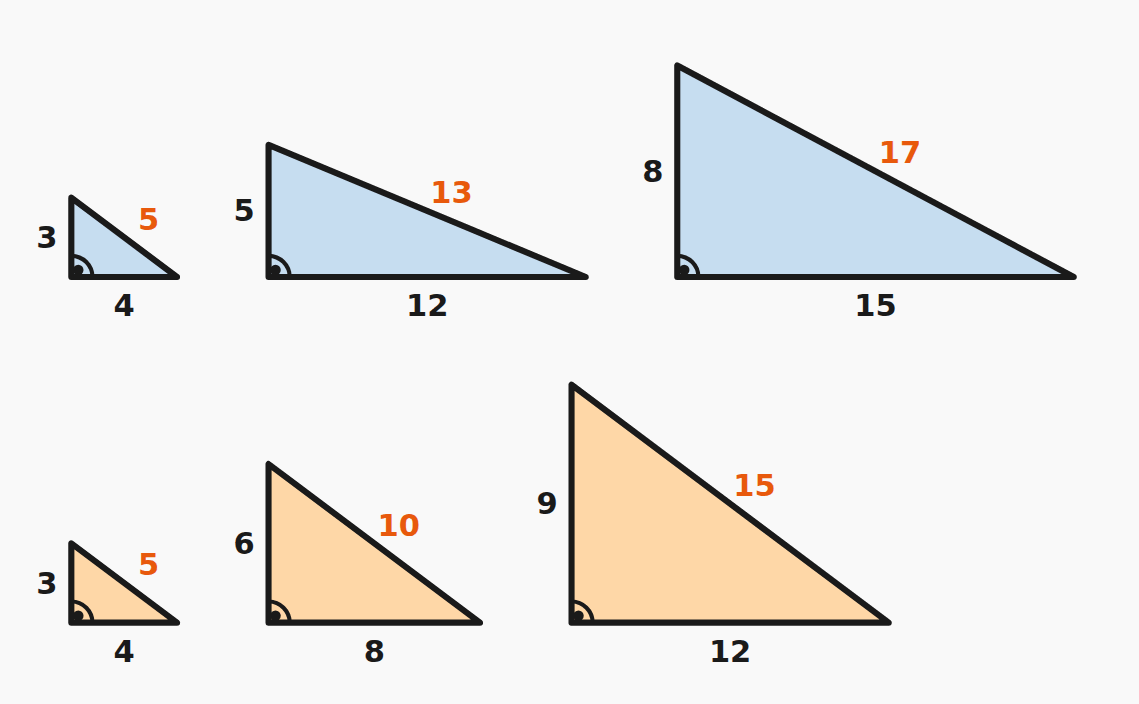
A Pythagorean triple is a triple of natural numbers (a,b,c) for which
a2+b2=c2.
In other words, they are the side lengths of a right triangle that are all whole numbers. Pythagorean triples are popular in textbooks because they give "nice" results without decimals.
The triple (3,4,5) is by far the most famous. Let's verify it:
32+42=9+16=25=52✓
A right triangle with legs 3 and 4 therefore has a hypotenuse of exactly 5. The ancient Egyptians already knew this triple – they used it to construct right angles when building the pyramids.
Primitive Pythagorean triples
A primitive Pythagorean triple is one in which the numbers a, b, c have no common divisor greater than 1 – in other words, you can't divide all three by the same number.
Examples of primitive triples:
(3,4,5)
(5,12,13)
(8,15,17)
(7,24,25)
(20,21,29)
(9,40,41)
Multiples of triples
From every Pythagorean triple we can create more by multiplying all three numbers by the same natural number. The resulting triple will also be Pythagorean.
Example: Multiply the triple (3,4,5) by 2:
(6,8,10)
62+82=36+64=100=102✓
And by 3:
(9,12,15)
92+122=81+144=225=152✓
So from a single primitive triple (3,4,5) we get infinitely many more: (6,8,10), (9,12,15), (12,16,20), (15,20,25), and so on.
List of the most commonly used triples
These triples are worth keeping "in your head" – they will speed up your problem solving:
a
b
c
3
4
5
5
12
13
6
8
10
7
24
25
8
15
17
9
12
15
9
40
41
11
60
61
12
16
20
20
21
29
How to create a new triple
There is a nice formula that generates primitive Pythagorean triples. For any natural numbers m>n>0: