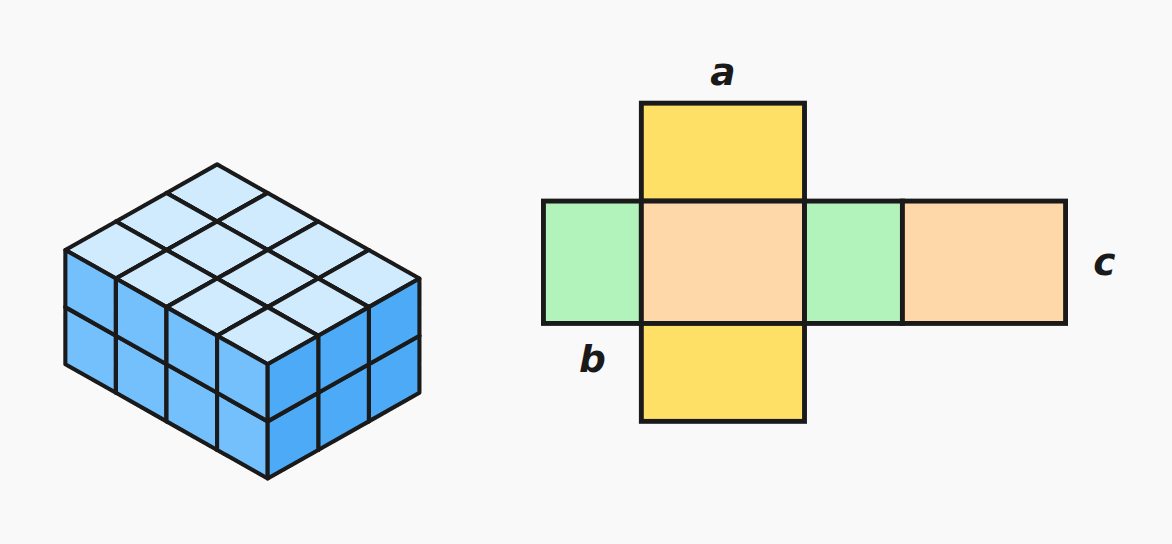
Cuboid
A cuboid has 6 faces, with opposite pairs being identical. The edges are `a`, `b`, `c`.
Example. A cuboid with `a = 5 cm`, `b = 4 cm`, `c = 3 cm`:SA = 2(ab + bc + ac)
SA = `2 · (5·4 + 4·3 + 5·3) = 2 · (20 + 12 + 15) = 2 · 47 = 94 cm²`.
Cube
A cube is a special cuboid with all edges equal (`a = b = c`).
Example. A cube with edge 5 cm: SA = `6 · 5² = 6 · 25 = 150 cm²`.SA = 6 · a²
Step by step
- Compute the areas of the three pairs of faces: `ab`, `bc`, `ac`.
- Multiply by 2 (each pair appears twice).
- Add the results.
Common pitfalls
- Edges in the same unit. If one is in cm and another in dm, convert first.
- Don't forget to multiply by 2. The formula has a 2 at the front.
- The unit of surface area is always square (cm², m²), not cubic.