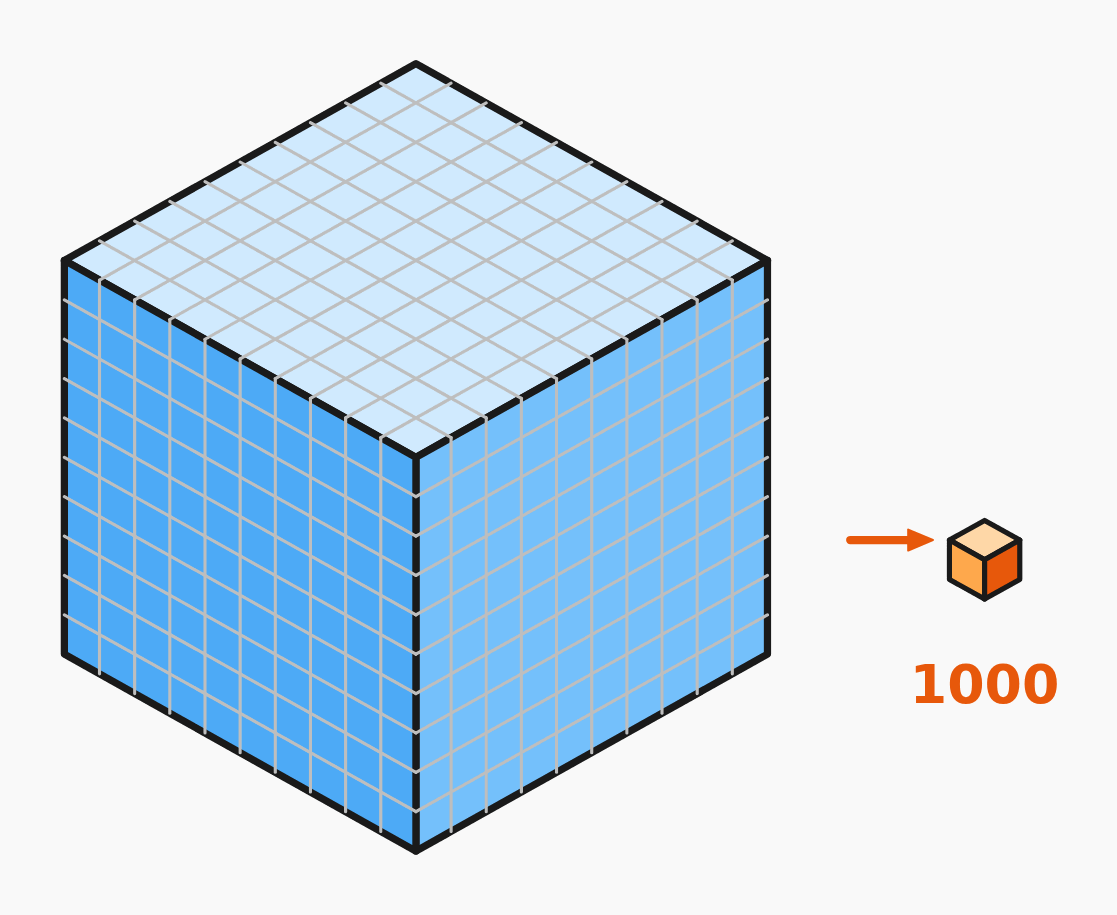
For length (m, dm, cm, mm) the step between neighbouring units is ×10. For volume the step is ×1000. That difference surprises most students on the first conversion.
Why 1000 and not 10?
A cube with edge 1 dm = 10 cm has volume `10 × 10 × 10 = 1000 cm³`. In other words, one cubic decimetre holds a thousand cubic centimetres. So:
1 dm³ = 1 000 cm³
1 m³ = 1 000 dm³
1 cm³ = 1 000 mm³
The step between neighbouring volume units is ×1000 or ÷1000.
A handy ladder
Largest to smallest:
m³  ─×1000→  dm³  ─×1000→  cm³  ─×1000→  mm³
m³  ←÷1000─  dm³  ←÷1000─  cm³  ←÷1000─  mm³
m³ to dm³: multiply by 1000. dm³ to m³: divide by 1000.
Litres and millilitres
These come from liquid measure but it's the same volume:
1 litre (l) = 1 dm³
1 millilitre (ml) = 1 cm³
So a 500 ml bottle holds 500 cm³ = 0.5 dm³.
Examples
dm³ to cm³:3 dm³ = 3 × 1000 = 3 000 cm³.
m³ to dm³:0.5 m³ = 0.5 × 1000 = 500 dm³ = 500 l.
cm³ to dm³:2 500 cm³ = 2 500 ÷ 1000 = 2.5 dm³.
m³ to cm³ (two steps):0.01 m³ = 0.01 × 1000 dm³ = 10 dm³ = 10 × 1000 cm³ = 10 000 cm³.
Common traps
- Don't confuse volume with area. Area between neighbouring units changes ×100 (1 m² = 100 dm² = 10 000 cm²); volume changes ×1000.
- When converting, always check: are you going bigger → smaller (multiply) or smaller → bigger (divide)?
- Litres and millilitres appear in word problems all the time. Always check whether you need dm³ or cm³.