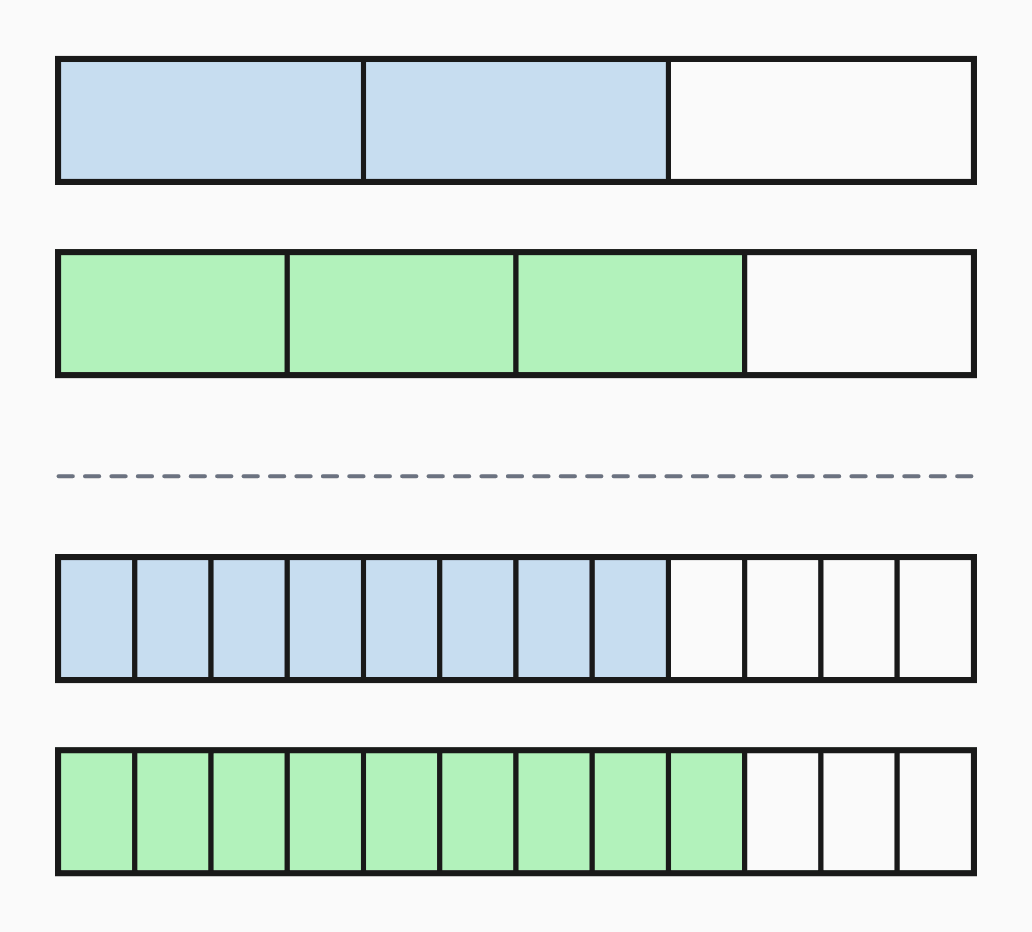
When two fractions have the same denominator, you just add or subtract the numerators. When they have different denominators, you first have to make them match — find a common denominator.
Why you can't add them straight away
A fraction tells you how many equal pieces the whole is split into. 1/2 and 1/3 are different-sized pieces, so you cannot simply add them. First you turn them into pieces of the same size.
Step by step
- Find a common denominator — the lowest common multiple (LCM) of the two denominators.
- Rewrite each fraction with that denominator (multiply the numerator and denominator by the same number).
- Add or subtract the numerators; the denominator stays the same.
- Simplify the result to its lowest terms.
Example — addition
Work out 1/2 + 1/3.
- The common denominator of 2 and 3 is 6.
- Rewrite: 1/2 = 3/6, 1/3 = 2/6.
- Add: 3/6 + 2/6 = 5/6.
- 5/6 cannot be simplified.
Result: 1/2 + 1/3 = 5/6.
Example — subtraction
Work out 3/4 − 1/6.
- The common denominator of 4 and 6 is 12.
- Rewrite: 3/4 = 9/12, 1/6 = 2/12.
- Subtract: 9/12 − 2/12 = 7/12.
- 7/12 cannot be simplified.
Result: 3/4 − 1/6 = 7/12.
Checking your answer
- Estimate the size: 1/2 + 1/3 is a little under 1 — and 5/6 really is just below 1. ✓
- Simplify: if the result can be reduced (e.g. 4/8), write it in lowest terms (1/2).
Common traps
- Adding the denominators. 1/2 + 1/3 is not 2/5! The denominator does not change when you add — you make it match first.
- Rewriting only one fraction. You must adjust both fractions to the common denominator.
- Forgetting to simplify. Always write the result in lowest terms.