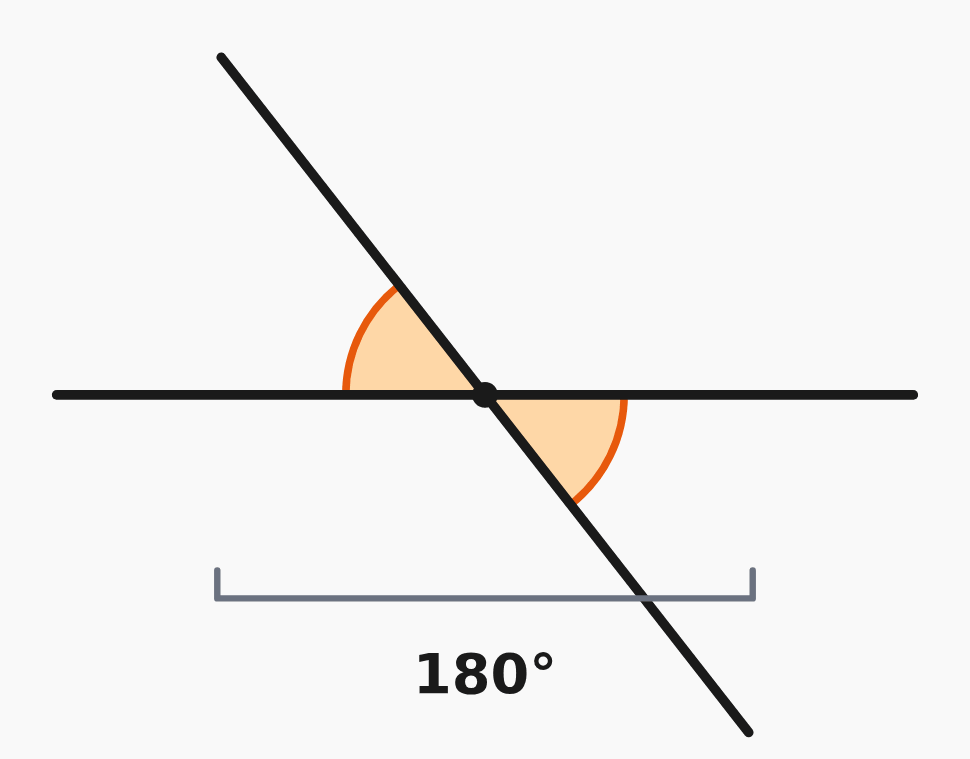
When two lines cross at a point, 4 angles appear. They are not random — two firm rules bind them.
Supplementary angles
Two angles that make up a straight line together are called supplementary. Their sum is always 180°.
Example. Next to a 35° angle is an angle of `180° − 35° = 145°`.If α and β are supplementary, α + β = 180°.
Vertical (vertically opposite) angles
Two angles directly across each other at a crossing are called vertical (vertically opposite) angles. They are equal.
Example. If one of the 4 angles is 50°, the one opposite to it is also 50°. The other two are each `180° − 50° = 130°` (and they are vertical to each other).If α and γ are vertical, α = γ.
Tips
- Supplementary angles are next to each other on a line.
- Vertical angles are diagonally across.
- At every cross of 2 lines there are always 4 angles forming 2 equal pairs.