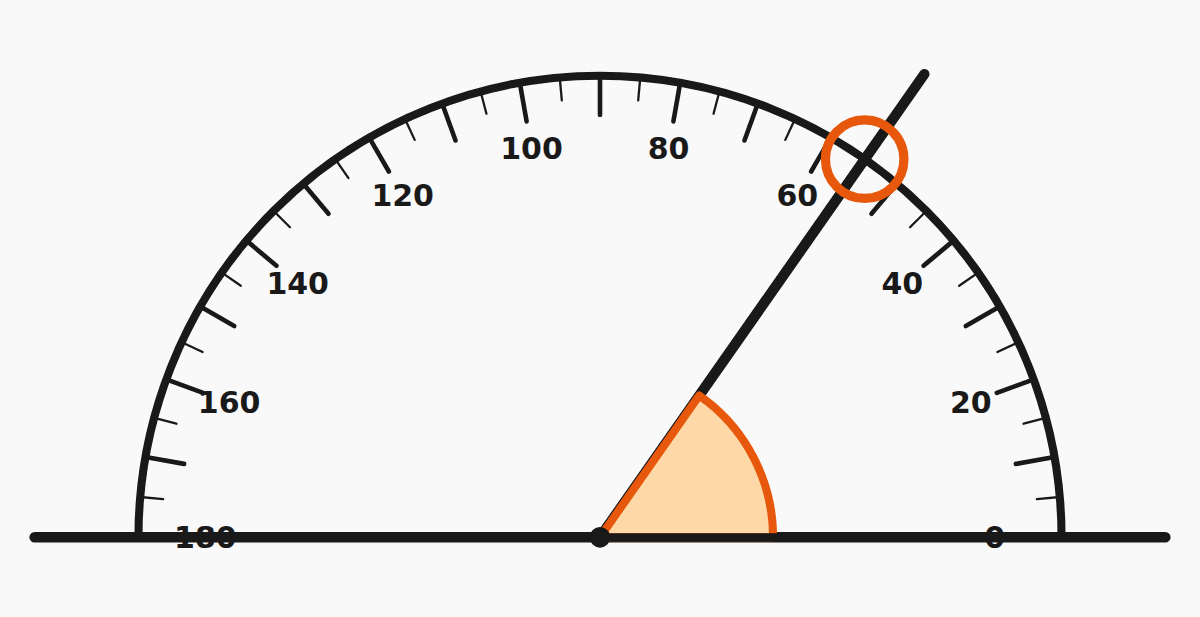
A protractor is a semicircular (or circular) tool with a scale from 0° to 180° (or 360°). You use it to measure the size of an angle.
Procedure
- Place the centre of the protractor exactly on the vertex of the angle.
- Line up the 0° line with one arm of the angle.
- Read the second arm where it crosses the scale.
The crucial detail: two scales
A standard protractor has two scales — one running left-to-right (0° to 180°) and one right-to-left. Use the scale whose 0 is on the arm you lined up with.
If you lined up with the left 0 and the other arm hits 60° on the inner scale and 120° on the outer, the correct reading is 60° (from the left 0).
Eye check
What type does the angle look like? (acute / right / obtuse)
- If it looks acute and your number is over 90°, you probably read the wrong scale.
- If it looks obtuse and your number is under 90°, same mistake.
Always have a rough idea of the answer before checking the number.
Example
The angle looks obtuse. With the protractor you read 30 on the inner scale and 150 on the outer. The angle is 150° (because it's obtuse).