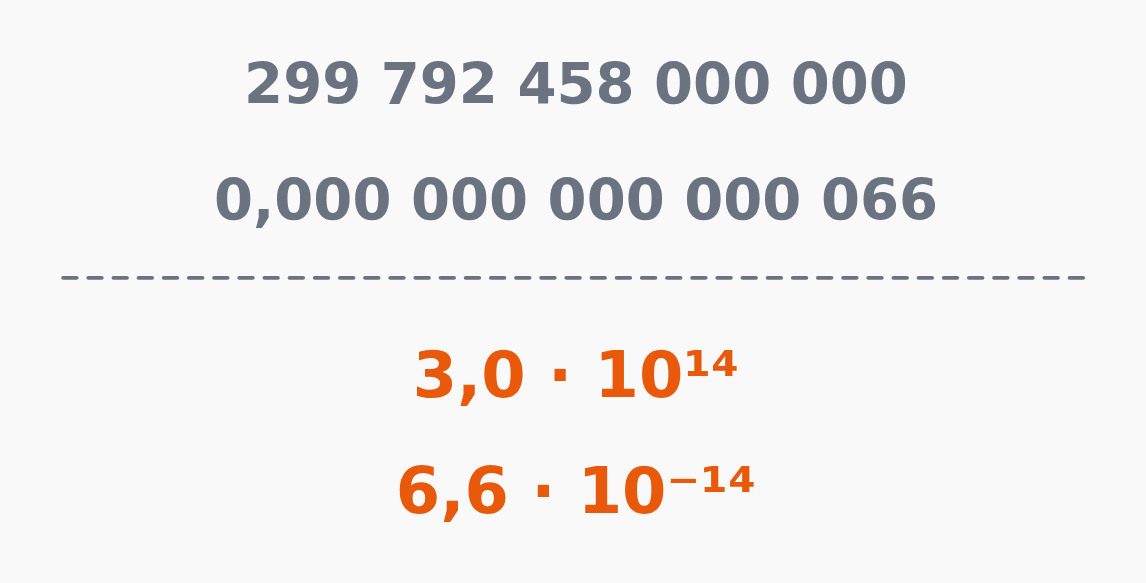
Some numbers in science are enormous — the distance to the Sun is about 150 000 000 km — and some are tiny. Writing all those zeros is slow and easy to get wrong. Scientific notation is a short, tidy way to write them.
The form a × 10ⁿ
A number in scientific notation looks like
a × 10ⁿ,
where the coefficient a is at least 1 and less than 10, and the exponent n is a whole number. The distance to the Sun becomes 1.5 × 10⁸ km — much shorter.
What the exponent tells you
The exponent counts how many places the decimal point sits away from where it would be in the plain number. A large number has a positive exponent; the bigger the exponent, the bigger the number. This makes huge numbers easy to compare at a glance.
Three rules that always help
- The coefficient must be at least 1 and less than 10.
- The exponent is a whole number that records the size.
- Scientific notation keeps long numbers short and easy to compare.
Keep going
- Read next: Converting to and from standard form
- Back to the scientific notation overview