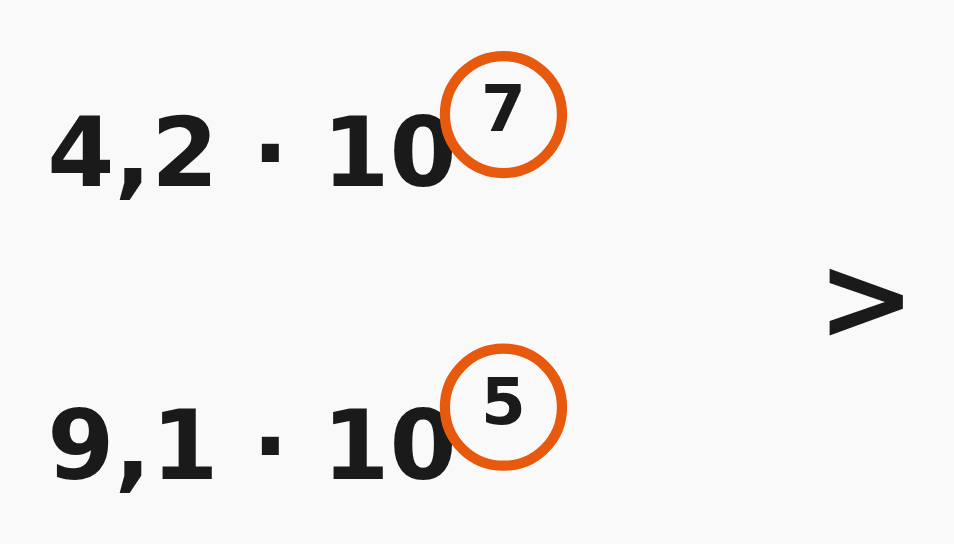
Scientific notation makes it quick to compare sizes, because the exponent already tells you how big a number is.
Compare the exponents first
If two numbers are both in scientific notation, the one with the larger exponent is larger. For example 3 × 10⁵ is bigger than 9 × 10⁴, because 10⁵ is ten times 10⁴ — the smaller coefficient does not matter once the exponent is bigger.
If the exponents are equal
When the exponents match, compare the coefficients. So 4.1 × 10⁶ is larger than 3.8 × 10⁶, because 4.1 > 3.8.
A quick check
You can always expand both numbers to standard form if you are unsure — but with practice the exponent-first method is much faster.
Three rules that always help
- Bigger exponent means bigger number.
- Equal exponents → compare the coefficients.
- When in doubt, expand both to standard form and compare.
Keep going
- Practice: Compare scientific notation
- Back to the scientific notation overview