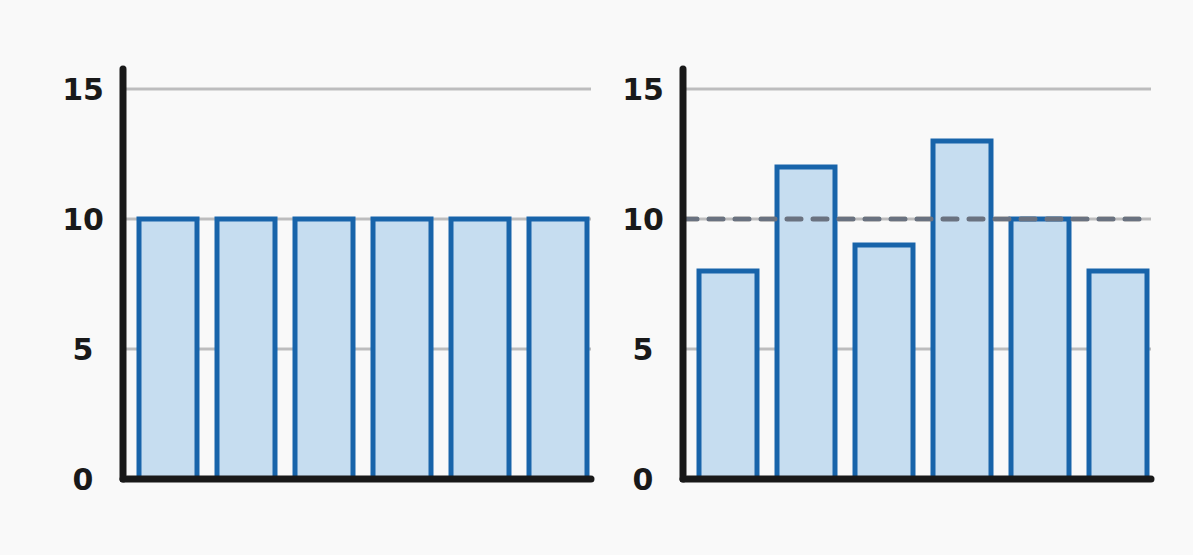
There are two ways to talk about how likely an event is. The theoretical probability comes from a model — for example, a fair die has six equally likely sides, so the theoretical probability of any one side is 1/6. The experimental probability comes from real data — you actually roll the die and count.
A small experiment
Roll a fair die 60 times and tally the results. You might get something like this:
| Side | 1 | 2 | 3 | 4 | 5 | 6 |
| Count | 9 | 12 | 8 | 11 | 11 | 9 |
The experimental probability of rolling a 5 in this experiment is
P_exp(5) = 11/60.
The theoretical value is
P_theo(5) = 1/6 = 10/60.
The two are close, but not equal. That is normal — small experiments rarely match the model exactly.
Why the two values usually disagree a little
Each roll is independent and random. With only 60 rolls, the count of any one side is allowed to wobble by a few. With 600 rolls the wobbles become smaller compared with the total; with 6000 rolls smaller still. This pattern — experimental probabilities approaching theoretical ones as we collect more data — is called the law of large numbers. In Year 7 we just notice it; the precise statement comes later.
A common mistake
A frequent error is to expect the experimental probability to be exactly equal to the theoretical one even in a short experiment. It almost never is. The right question is "are the two close?", not "are they equal?".
How to write the answers
- Experimental probability is always written from the data: observed count divided by number of trials.
- Theoretical probability is always written from the model: number of favourable outcomes divided by number of equally likely outcomes.
- Both are fractions in Year 7 — keep them as 11/60 or 1/6, not 0.183… or 0.166….