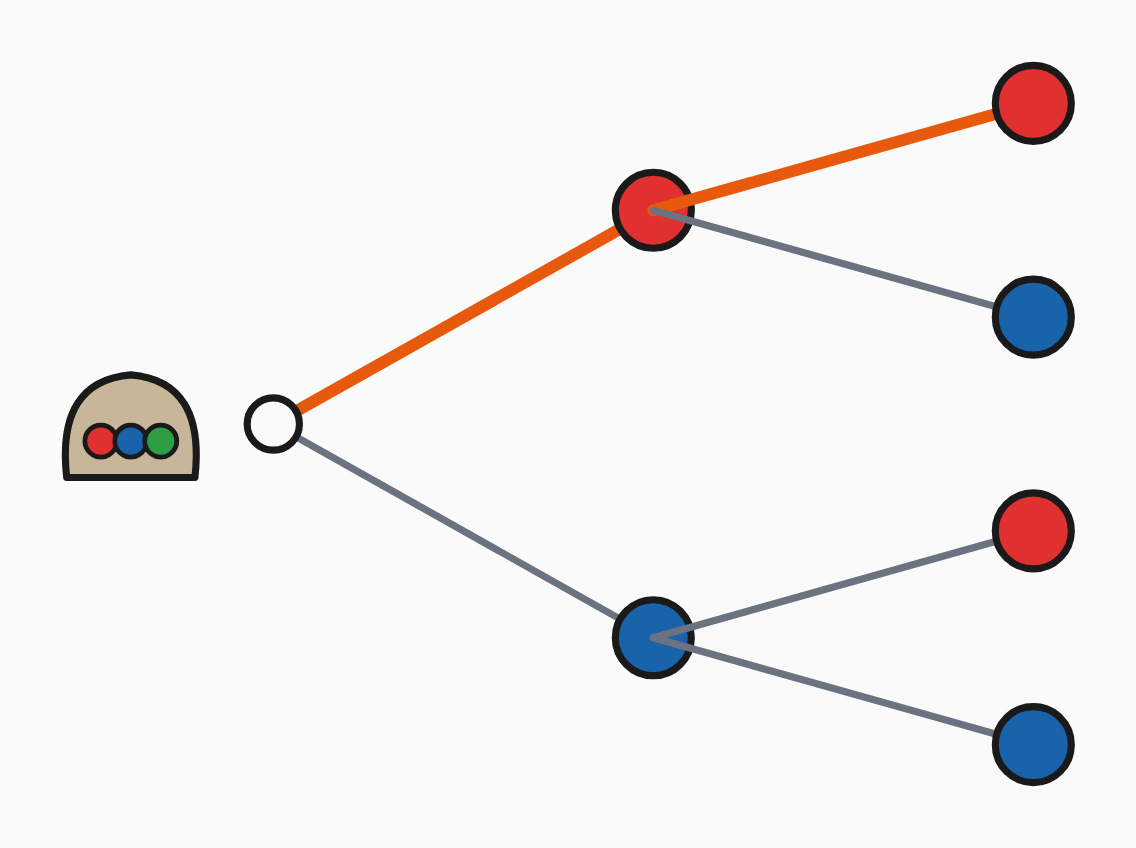
Sometimes we want the probability of two events happening together. If the events are independent — one does not affect the other — we multiply their probabilities.
Coin and die
Flip a fair coin and roll a fair die. What is the probability of getting heads AND a 6? The coin and the die are independent, so
P(H AND 6) = P(H) · P(6) = 1/2 · 1/6 = 1/12.
You can also confirm this by listing the sample space. The 12 equally likely outcomes are:
H1, H2, H3, H4, H5, H6, T1, T2, T3, T4, T5, T6.
Only one of those — H6 — matches. So the probability is 1/12.
Sample space — two coins
The sample space is the set of every possible outcome. For tossing two coins it has four equal outcomes:
{ HH, HT, TH, TT }
A common mistake is to think HT and TH are the same outcome. They are not — the first coin and the second coin are different objects, so a head on the first and a tail on the second is a different outcome from the reverse.
Random sampling
We rarely have time to ask every person in a big group, so we ask a smaller random sample and scale up. The fraction observed in the sample is our best guess for the fraction in the whole population.
A short example
A school has 500 students. We ask 50 random students whether they own a dog. 12 of them say yes. The fraction in the sample is
12 / 50 = 24/100.
To estimate the count in the whole school, we apply the same fraction:
(12 / 50) · 500 = 120 students.
So we estimate that about 120 students at the school own a dog. The word "about" is important — different random samples give slightly different estimates.
Why the sample must be random
Imagine we only asked students who happened to be standing near the school's pet-care club. Their answers would not represent the whole school — that group is more likely to own pets. To make a fair estimate we must pick the sample randomly.
Three rules that always help
- For independent events, multiply: P(A AND B) = P(A) · P(B).
- For a sample space, list every distinguishable outcome and count.
- For random sampling, the answer is always an estimate; bigger samples give better estimates.