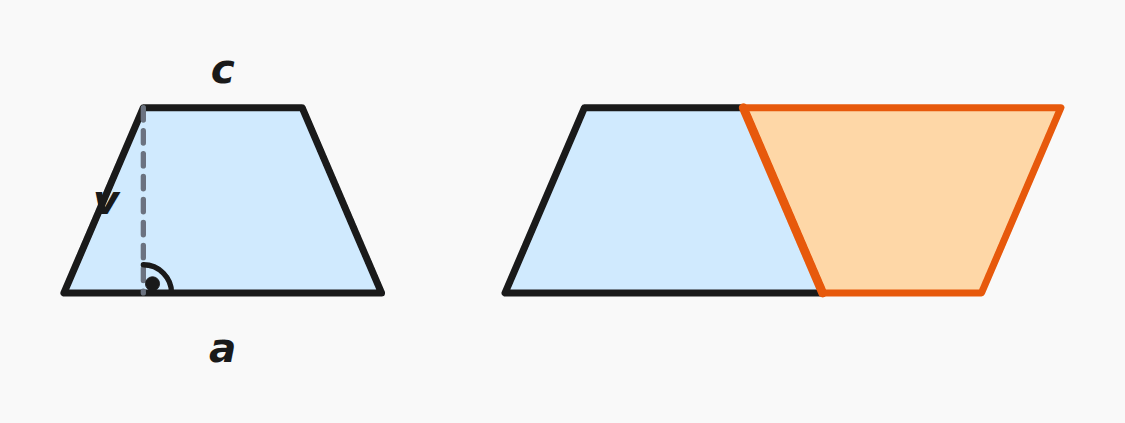
A trapezoid has two parallel bases of different lengths: a longer base `a` and a shorter base `c`. The height `h` is the perpendicular distance between them.
The area of a trapezoid is
A = ((a + c) × h) ÷ 2
In words: add the longer and the shorter base, multiply by the height, divide by 2.
Why this particular formula
If the trapezoid had its two bases equal (`a = c`), it would be a parallelogram with area `a × h`. Since the bases differ, we use their average instead of one length: `(a + c) ÷ 2`. Multiplying by the height then gives the area.
Another way to see it: two identical trapezoids glued so that the short base is on top and bottom form a parallelogram with base `a + c` and height `h`. One trapezoid is half of that → formula.
Worked example
A trapezoid has `a = 8 cm`, `c = 5 cm`, `h = 4 cm`. Find its area.
- Sum of bases: `8 + 5 = 13 cm`.
- Times the height: `13 × 4 = 52 cm²`.
- Divide by 2: `52 ÷ 2 = 26 cm²`.
The area is 26 cm².
Watch the height
- The height must be perpendicular to the bases, not the slanted side.
- In a skewed trapezoid the height is usually drawn inside as a dashed line.
- If the problem only gives slanted sides, you'll first need to find the perpendicular height (usually through a right triangle).
Special trapezoids
- Right trapezoid: one of the legs is perpendicular to the bases — that leg is itself the height.
- Isosceles trapezoid: the two legs are equal in length. A line of symmetry passes through the midpoints of both bases.
Common mistakes
- Forgetting to divide by 2 — that gives a parallelogram's area, not a trapezoid's.
- Adding the legs instead of the bases.
- Using a slanted side as the height.