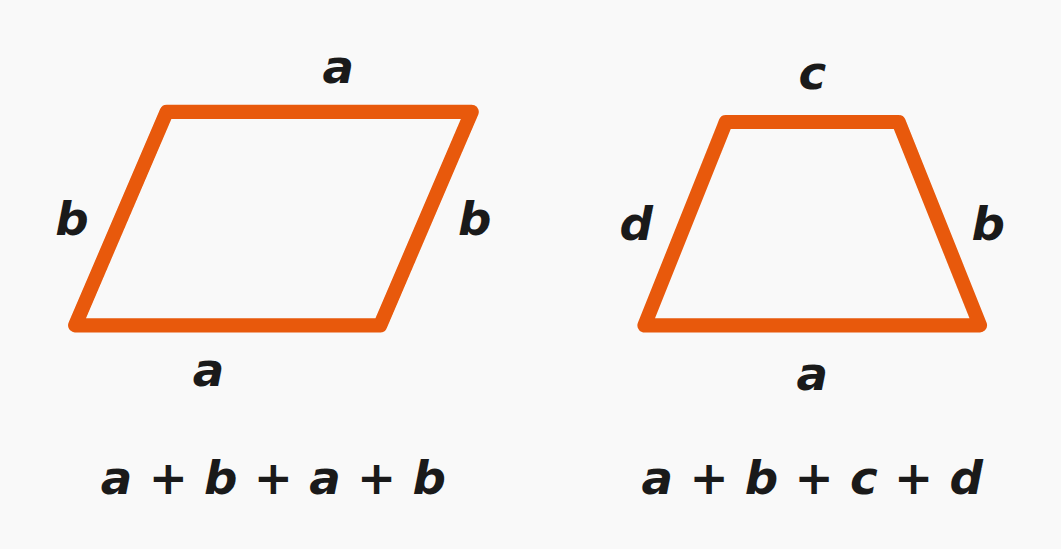
The perimeter is the sum of the lengths of all the sides. For quadrilaterals, that is always 4 sides.
Parallelogram
A parallelogram has its opposite sides equal: `a` and `b`. Therefore:
Example. A parallelogram with sides `a = 8 cm`, `b = 5 cm`:o = 2a + 2b = 2(a + b)
o = `2 · (8 + 5) = 26 cm`.
Trapezoid
A trapezoid has four different sides: the bottom base `a`, the top base `c`, and two legs `b` and `d`. The formula is simply the sum:
Example. A trapezoid with `a = 10`, `b = 6`, `c = 7`, `d = 5` (cm):o = a + b + c + d
o = `10 + 6 + 7 + 5 = 28 cm`.
Isosceles trapezoid
In an isosceles trapezoid both legs are equal (`b = d`), so:
o = a + c + 2b
Watch out for units
- All sides must be in the same units before you add them.
- If one is in cm and another in dm, convert first.