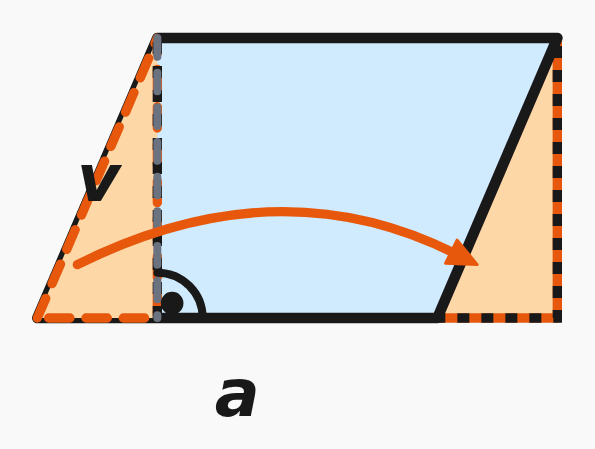
A parallelogram has two pairs of parallel sides. The sides are called `a` (the bottom) and `b` (the side, slanted). The height `v` is the perpendicular distance between the two parallel sides.
Area of a parallelogram:
S = a · v
In words: multiply the longer side (the base) by the height.
Why it works
From a parallelogram you "cut off" a right-angled triangle on one side and move it to the other. You get a rectangle with the same base `a` and the same height `v`. The area has not changed — that is why `S = a · v`, just like for a rectangle.
Watch out for the height
- The height must be perpendicular to the base, not the slanted side `b`.
- In a slanted parallelogram, the height is usually drawn inside as a dashed line.
- If you are only given the sides, you need extra information to find the height.
Example
A parallelogram has `a = 7 cm` and height `v = 4 cm`. Area = `7 · 4 = 28 cm²`.
Common traps
- Do not confuse the height `v` with the slanted side `b`.
- For a parallelogram with right angles (a rectangle), both sides are also heights — that is a special case.