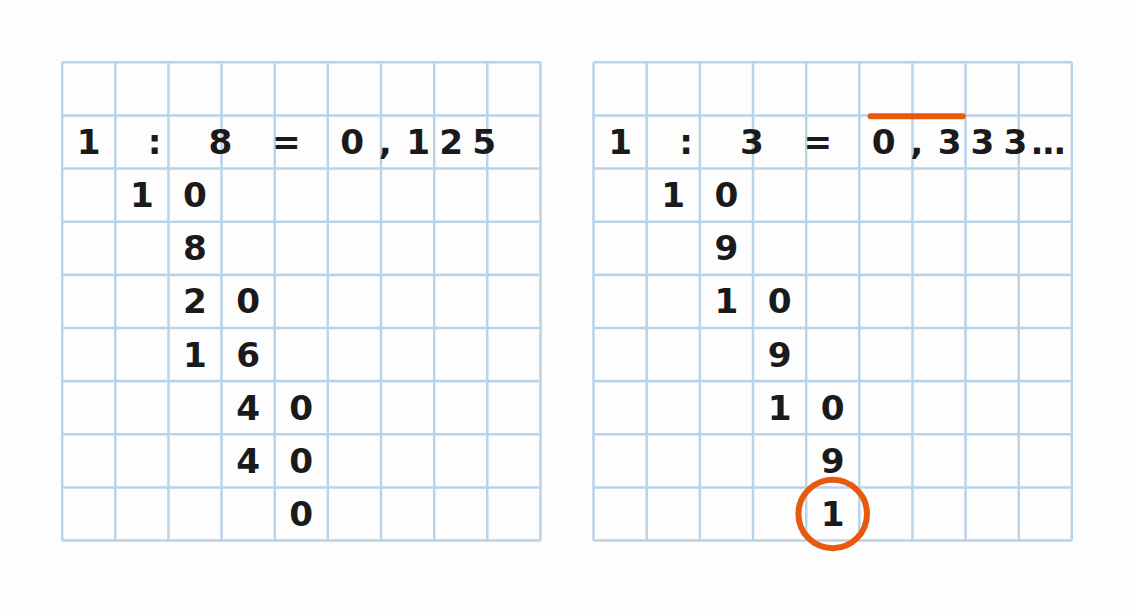
Try `1 ÷ 4` in your head. You get a clean 0.25 — done. Now try `1 ÷ 3`. You get 0.333… — the threes go on forever. Why?
The answer is short: it depends only on the denominator of the fraction in lowest terms.
The rule
A fraction `n/d` in lowest terms is:
- terminating — if the denominator `d` only has 2 and 5 as prime factors (or none);
- recurring — if `d` has any other prime factor (3, 7, 11, 13, …).
Examples — terminating
| fraction | decimal | denominator |
| 1/2 | 0.5 | 2 |
| 1/4 | 0.25 | 4 = 2·2 |
| 1/5 | 0.2 | 5 |
| 1/8 | 0.125 | 8 = 2³ |
| 3/20 | 0.15 | 20 = 2²·5 |
Examples — recurring
| fraction | decimal | denominator |
| 1/3 | 0.333… | 3 |
| 1/6 | 0.1666… | 6 = 2·3 |
| 1/7 | 0.142857142857… | 7 |
| 1/9 | 0.111… | 9 = 3² |
| 5/11 | 0.4545… | 11 |
In some cases (1/6, 1/12, …) the recurrence does not start immediately — you get a couple of fixed digits first and then the repeat. That is still a recurring decimal.
Why it works
Our base-10 system has base 10 = 2 × 5. To convert `n/d` neatly into a decimal, you need to express the denominator as a power of ten. This is only possible when `d` has only 2s and 5s in its factorisation.
Rewriting as a power of 10: `1/8 = 125/1000` (we multiplied by 125 since 8 × 125 = 1000). That gives 0.125.
If the denominator also has a 3 or 7 or another "odd" prime factor, you can never push it into a power of 10 — so the expansion necessarily repeats.
Recognition tips
- First reduce the fraction to lowest terms.
- Look at the denominator: if you can break it down to 2s and 5s only, it terminates.
- 6 = 2 × 3 → recurs. 12 = 2² × 3 → recurs. 21 = 3 × 7 → recurs.