Table of Contents
- Equivalent Transformations
- The Sign-Reversal Rule
- Solving Procedure
- Interval Notation Quick Reference
- Solution Types
- Formula Sheet
- Practice Exercises
- Related Articles
An equivalent transformation changes the form of an inequality without changing its solution set.
| Transformation | Effect on Direction |
| Add the same number to both sides | no change |
| Subtract the same number from both sides | no change |
| Multiply both sides by a positive number | no change |
| Divide both sides by a positive number | no change |
| Multiply both sides by a negative number | reverses |
| Divide both sides by a negative number | reverses |
2. The Sign-Reversal Rule
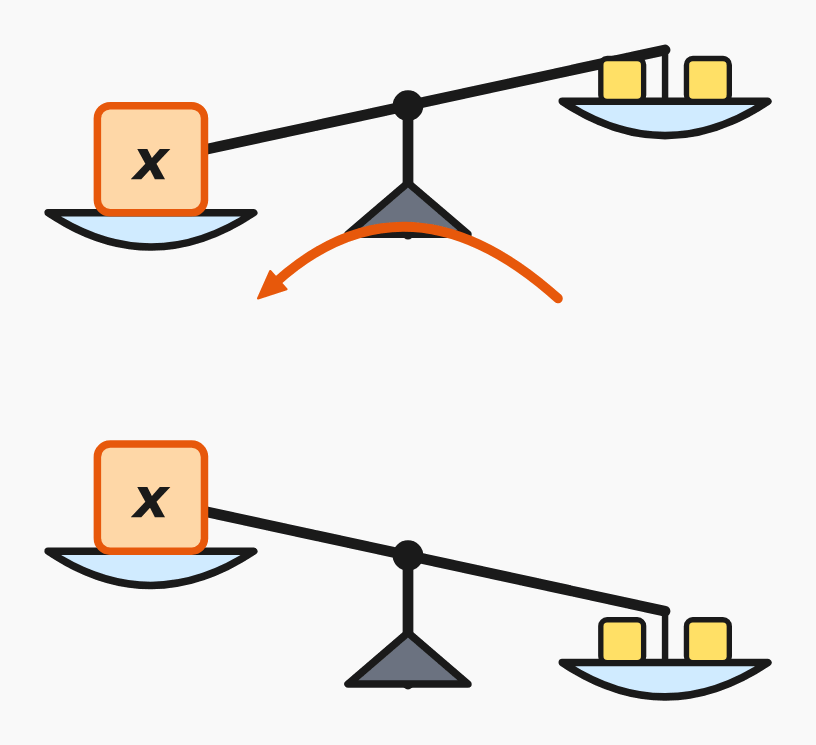
The single most important rule: When you multiply or divide both sides of an inequality by a negative number, you must flip the inequality sign.
| Original | After multiplying/dividing by negative |
| < | > |
| > | < |
| ≤ | ≥ |
| ≥ | ≤ |
−3x≤12⇒x≥−4
We divided by −3 (negative), so ≤ became ≥.
3. Solving Procedure
Step 1: Expand parentheses (if any)
Step 2: Eliminate fractions by multiplying by the LCD (if any)
Step 3: Move all terms with
x to one side, all constants to the other
Step 4: Combine like terms
Step 5: Divide by the coefficient of
x (flip the sign if the coefficient is negative!)
Step 6: Write the solution in inequality, interval, or number line form
Step 7: Check by substituting a value from the solution set
4. Interval Notation Quick Reference
| Inequality | Interval | Boundary |
| x>a | (a,∞) | excluded |
| x≥a | [a,∞) | included |
| x<a | (−∞,a) | excluded |
| x≤a | (−∞,a] | included |
Remember: Infinity always gets a round bracket. The boundary gets a round bracket for strict (<, >) and a square bracket for non-strict (≤, ≥).
5. Solution Types
| Outcome | What Happens | Solution |
| Normal | x compared to a number | an interval |
| No solution | false statement (e.g. 0>5) | ∅ |
| All reals | true statement (e.g. 0<5) | R |
| Inequality Type | Solution (a>0) |
| ax+b>c | x>ac−b |
| ax+b<c | x<ac−b |
| ax+b≥c | x≥ac−b |
| ax+b≤c | x≤ac−b |
When a<0 (sign reverses!)
| Inequality Type | Solution (a<0) |
| ax+b>c | x<ac−b |
| ax+b<c | x>ac−b |
| ax+b≥c | x≤ac−b |
| ax+b≤c | x≥ac−b |
Variable on Both Sides
For ax+b>cx+d where a=c:
x>a−cd−bif a−c>0
x<a−cd−bif a−c<0
Practice Exercises
Related Articles