Table of Contents
- Why Use a Number Line?
- Open and Closed Circles
- Representing Basic Inequalities
- Reading Solutions from a Number Line
- From Inequality to Number Line
- Common Mistakes
- Practice Exercises
- Related Articles
1. Why Use a Number Line?
A number line gives you a visual picture of all the numbers that satisfy an inequality. Instead of just writing , you can see at a glance which part of the number line is included in the solution.
Key idea: A number line diagram shows the boundary point and the direction of the solution set using circles and shaded regions.
2. Open and Closed Circles
There are two types of circles used on the number line:
| Circle | Meaning | Used for | Symbol |
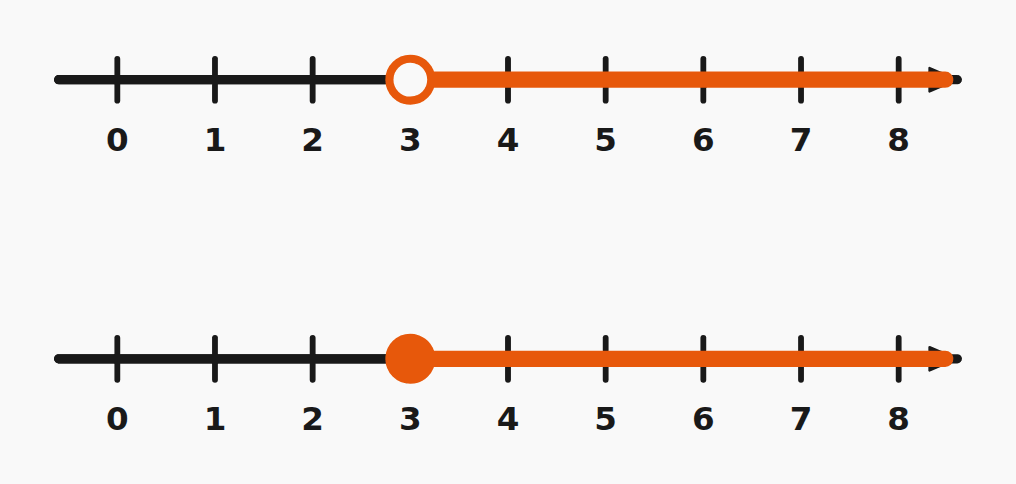
| Open circle (hollow) | boundary point is not included | and | |
| Closed circle (filled) | boundary point is included | and |
Remember: Strict inequalities (, ) use an open circle. Non-strict inequalities (, ) use a filled circle.
3. Representing Basic Inequalities
Example 1: (strict, greater than)
The solution includes all numbers to the right of 3, but not 3 itself.
- Open circle at 3 (3 is not included)
- Blue region extends to the right toward
- Interval notation:
Example 2: (non-strict, less than or equal)
The solution includes all numbers to the left of , including itself.
- Filled circle at ( is included)
- Blue region extends to the left toward
- Interval notation:
Example 3: (non-strict, greater than or equal)
The solution includes zero and all positive numbers.
- Filled circle at 0 (0 is included)
- Blue region extends to the right
- Interval notation:
Example 4: (strict, less than)
The solution includes all numbers to the left of 5, but not 5 itself.
- Open circle at 5 (5 is not included)
- Blue region extends to the left toward
- Interval notation:
4. Reading Solutions from a Number Line
When you see a number line diagram, you can convert it back to an inequality:
- Identify the boundary point (the number under the circle)
- Check the circle type --- open means strict, filled means non-strict
- Check the direction of the shaded region
| Shaded region | Circle | Inequality | Interval |
| right of | open | ||
| right of | filled | ||
| left of | open | ||
| left of | filled |
Tip: Think of the open circle as a "hole" --- the boundary value has been removed from the solution.
5. From Inequality to Number Line
Here is a step-by-step process for drawing any linear inequality on a number line:
Step 1: Solve the inequality to get it in the form , , , or . Step 2: Draw a horizontal line and mark the boundary value . Step 3: Draw the correct circle at :- Open circle for or
- Filled circle for or
- Shade to the right for or
- Shade to the left for or
Worked Example
Solve and represent on a number line:
Solving:6. Common Mistakes
Mistake 1: Mixing Up Circle Types
For : use an open circle (3 is not a solution).
For : use a filled circle (3 is a solution).
Mistake 2: Shading the Wrong Direction
For : shade to the left (toward smaller numbers).
For : shade to the right (toward larger numbers).
Mistake 3: Forgetting to Solve First
Always solve the inequality completely before drawing the number line. Do not try to graph directly --- first simplify to .
Practice Exercises
- Inequalities - Number Line - Draw and read number line diagrams
- Inequalities - Intervals - Convert between number lines and intervals
- Inequalities - addition and subtraction - Solve and graph simple inequalities
Related Articles
- Linear Inequalities - Comprehensive Guide - Full introduction to linear inequalities
- Linear Inequalities - Intervals and Sets - Writing solutions with interval notation
- Linear Inequalities - Simple Inequalities - Solving basic inequality types
- Linear Inequalities - Rules and Formulas - Quick reference card