Table of Contents
- What is an Interval?
- Types of Intervals
- Intervals for Inequality Solutions
- Set-Builder Notation
- Conversion Table
- Special Cases
- Worked Examples
- Common Mistakes
- Practice Exercises
- Related Articles
1. What is an Interval?
An interval is a way of describing a continuous set of numbers between two endpoints. Instead of listing individual solutions, we write a compact notation that captures all the numbers at once.
Key idea: Every linear inequality in one variable has a solution that can be expressed as an interval (or as the empty set, or as all real numbers).
2. Types of Intervals
Open Interval
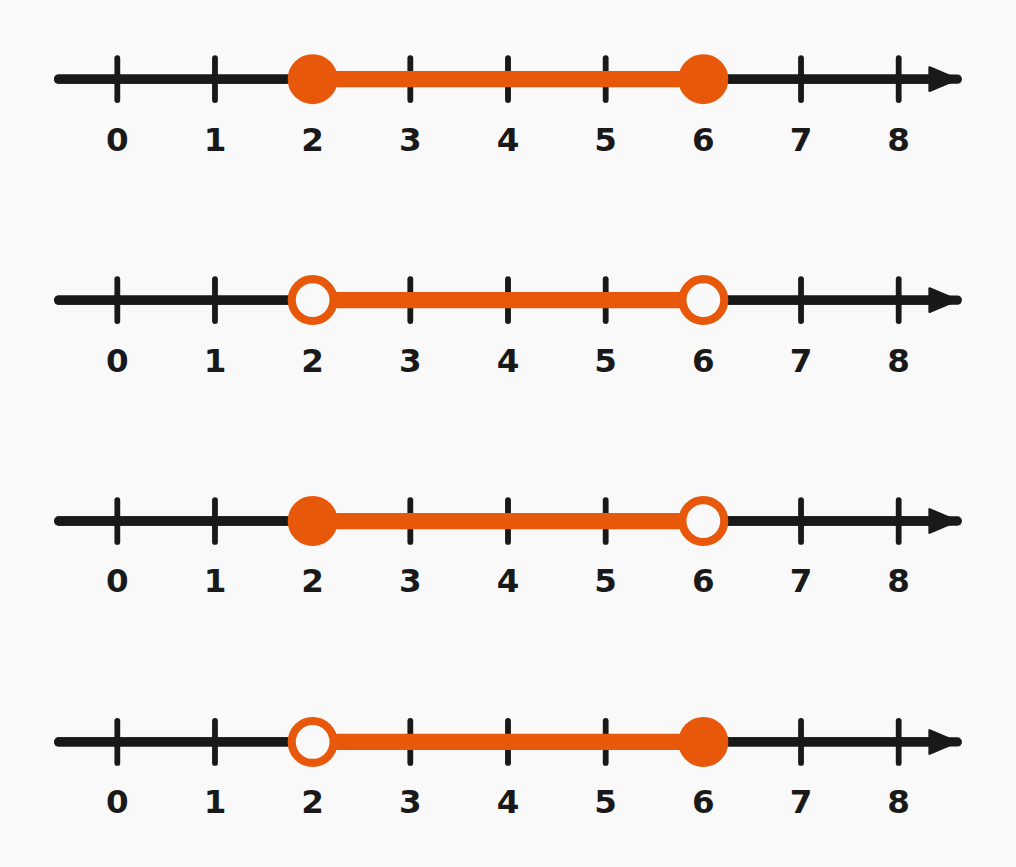
An open interval contains all numbers between and , but not the endpoints themselves.
Closed Interval
A closed interval contains all numbers between and , including both endpoints.
Half-Open (Half-Closed) Intervals
These include one endpoint but not the other:
Unbounded Intervals
When the solution extends to infinity, we use or :
| Interval | Meaning |
| all numbers greater than | |
| all numbers greater than or equal to | |
| all numbers less than | |
| all numbers less than or equal to | |
| all real numbers |
Important: Infinity is not a real number, so we always use a round bracket next to or . Never write or .
3. Intervals for Inequality Solutions
Linear inequalities with one variable always produce unbounded intervals:
| Inequality | Interval | Bracket at boundary |
| round (open) | ||
| square (closed) | ||
| round (open) | ||
| square (closed) |
The rule is straightforward:
- Strict inequality (, ) uses a round bracket --- the boundary is excluded
- Non-strict inequality (, ) uses a square bracket --- the boundary is included
4. Set-Builder Notation
Another way to write solutions is set-builder notation:
This reads: "the set of all real numbers such that is greater than 3."
| Interval | Set-Builder Notation |
Note: In most school contexts, interval notation is preferred because it is shorter. Set-builder notation is useful when the condition is more complex.
5. Conversion Table
Here is a complete reference for converting between the three notations:
| Inequality | Interval | Set-Builder | Number Line |
| open circle, shade right | |||
| filled circle, shade right | |||
| open circle, shade left | |||
| filled circle, shade left |
6. Special Cases
Empty Set (No Solution)
When an inequality has no solution, we write:
This happens when simplifying leads to a false statement like .
All Real Numbers
When every number is a solution, we write:
This happens when simplifying leads to a true statement like .
7. Worked Examples
Example 1
Solve and express the solution in all three notations.
- Inequality:
- Interval:
- Set-builder:
Example 2
Solve and express the solution in all three notations.
- Inequality:
- Interval:
- Set-builder:
Example 3
Solve and express the solution.
This is always true.
- Inequality: all
- Interval:
- Set-builder:
8. Common Mistakes
Mistake 1: Using a Square Bracket with Infinity
Wrong:
Correct: --- always a round bracket at infinity
Mistake 2: Confusing Round and Square Brackets
For :
Wrong: --- this includes 5
Correct: --- this excludes 5
Mistake 3: Reversed Interval Endpoints
Wrong:
Correct: --- the smaller value always comes first
Practice Exercises
- Inequalities - Intervals - Practice writing intervals
- Inequalities - Number Line - Convert between diagrams and notation
- Inequalities - addition and subtraction - Solve and write solutions
Related Articles
- Linear Inequalities - Comprehensive Guide - Full introduction to linear inequalities
- Linear Inequalities - Number Line - Graphical representation of solutions
- Linear Inequalities - Rules and Formulas - Quick reference for rules
- Linear Inequalities - Special Cases - Empty set and all real numbers