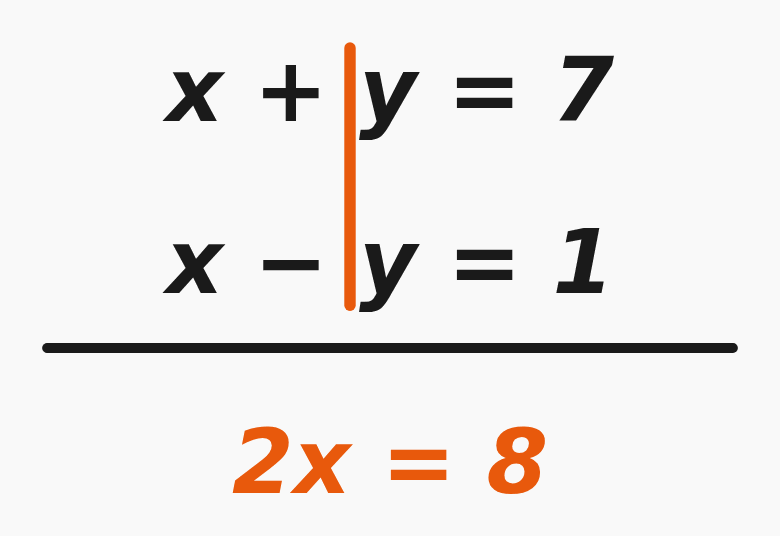
Elimination works best when both equations are in the form ax + by = c. The idea is to make one variable cancel when you add or subtract the equations.
A worked example
2x + y = 7
x − y = −1
Add the two equations: the +y and −y cancel, leaving 3x = 6, so x = 2. Put x = 2 into the second equation: 2 − y = −1 → y = 3. The solution is (2, 3).
When nothing cancels yet
If neither variable cancels straight away, multiply one or both equations by a number so a pair of coefficients match in size. Then add (if the signs are opposite) or subtract (if they are the same).
Three rules that always help
Use elimination when both equations are in standard form.
Make a pair of coefficients equal in size, then add or subtract to cancel.
Solve for the remaining variable, substitute back, and check.