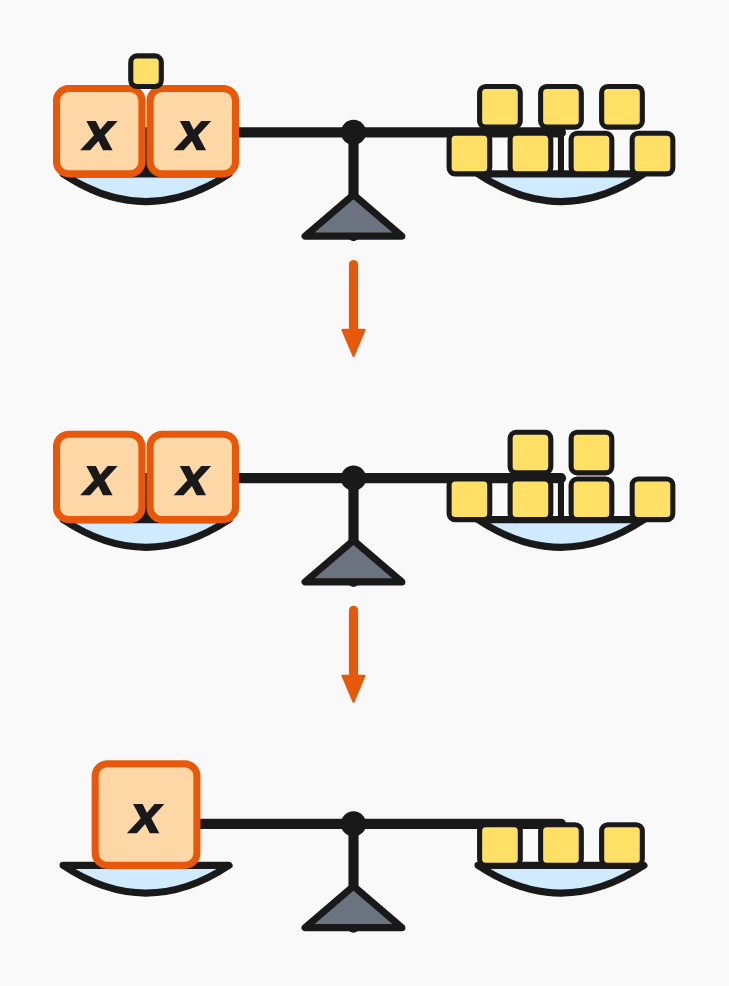
The same recipe works for every linear equation in grade 7:
**Undo operations one by one, in reverse order, while doing the same
thing to both sides.**
px + q = r — two steps
3x + 5 = 14- Subtract 5 from both sides → `3x = 9`.
- Divide by 3 on both sides → `x = 3`.
That order matters: you "peel off" the outermost operation first.
Here the outermost was the `+ 5`, so we undo that before the `·3`.
p(x + q) = r — two paths
3(x + 2) = 183x + 6 = 18 (distribute)
3x = 12 (subtract 6)
x = 4 (divide by 3)x + 2 = 6 (divide by 3)
x = 4 (subtract 2)Both arrive at `x = 4`. Use Path B when `r` is divisible by p —
it's faster.
ax + b = cx + d — collect like terms
2x + 5 = x + 11- Subtract `x` from both sides → `x + 5 = 11`.
- Subtract 5 from both sides → `x = 6`.
Tip: subtract the smaller x-coefficient. That always leaves a
positive coefficient in front of `x` and avoids sign mistakes.
One-step inequalities
x + 3 > 7Subtract 3 from both sides → `x > 4`.
Important — adding/subtracting the same number does not flip the
inequality. Multiplying or dividing by a negative number does
(we leave that for grade 8).
Checking your answer
After solving, substitute back into the original equation:
3 · 3 + 5 = 9 + 5 = 14 ✓A quick check catches typos and sign mistakes — always worth 5 seconds.