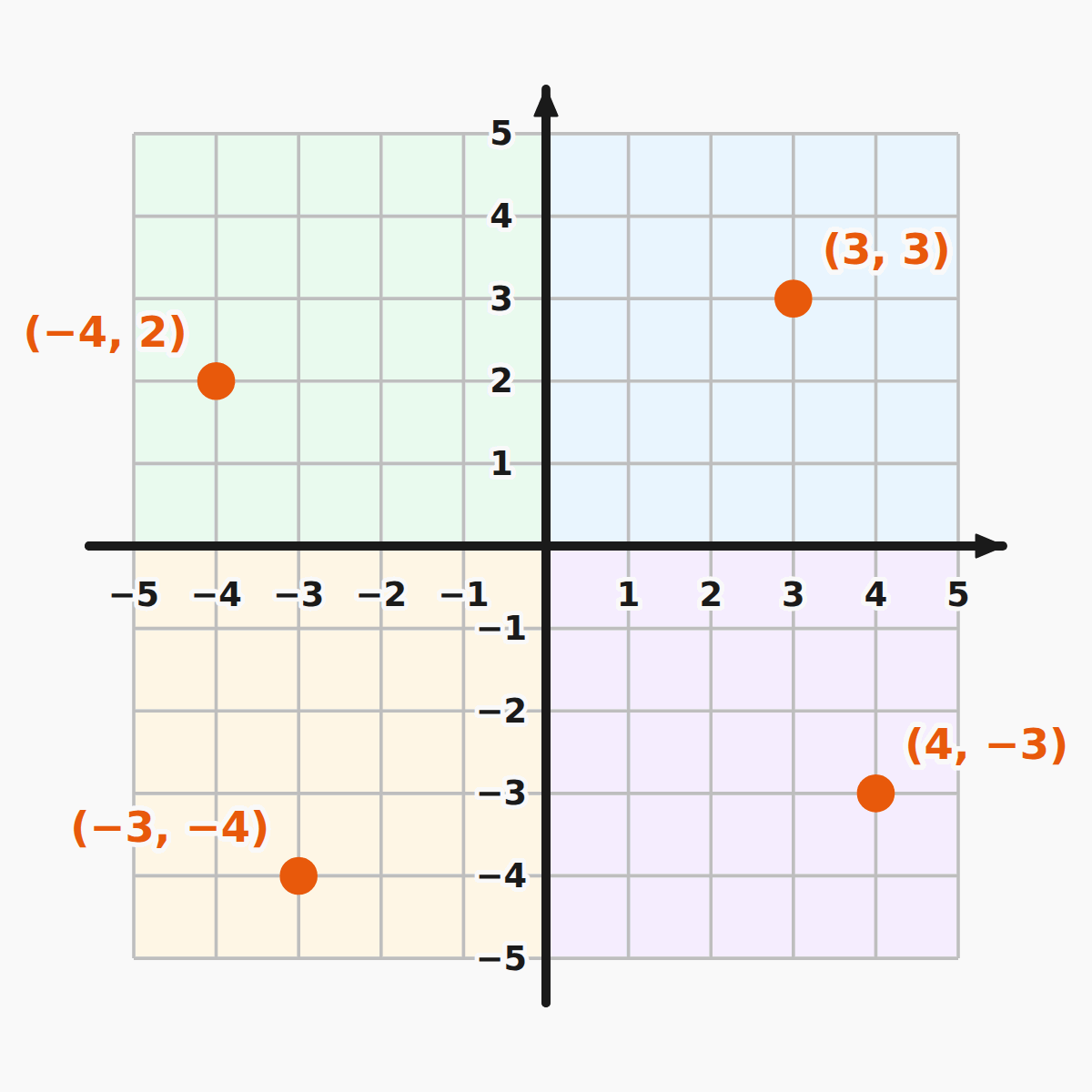
In earlier grades you worked with coordinates only in the first quadrant — both `x` and `y` were positive. In Year 6 the plane is extended to all four quadrants by allowing negative values too.
The four quadrants
The two axes split the plane into four regions. The axes themselves don't belong to any quadrant.
| Quadrant | x | y |
| I (top right) | + | + |
| II (top left) | − | + |
| III (bottom left) | − | − |
| IV (bottom right) | + | − |
The origin `(0, 0)` sits where the axes cross.
Plotting `(x, y)` with signs
Read the sign of each coordinate first.
- x first: positive → go right, negative → go left.
- y next: positive → go up, negative → go down.
- The point is at the intersection of those two moves.
Reading coordinates
Given a point in the plane:
- Drop a vertical line to the x-axis. The number there (with its sign) is the x-coordinate.
- Drop a horizontal line to the y-axis. The number there (with its sign) is the y-coordinate.
- Write the pair in the order `(x, y)`.
Reflecting a point
Reflection sends a point to its mirror image across an axis or the origin.
Example. `A = (3, 2)`.Over the x-axis: x stays the same, y changes sign. `(a, b) → (a, −b)`.
Over the y-axis: y stays the same, x changes sign. `(a, b) → (−a, b)`.
Through the origin: both signs flip. `(a, b) → (−a, −b)`.
- Reflected over the x-axis: `A' = (3, −2)`.
- Reflected over the y-axis: `A' = (−3, 2)`.
- Reflected through the origin: `A' = (−3, −2)`.
Quick checklist
- Read the sign of each coordinate before moving.
- Always write `(x, y)`, never `(y, x)`.
- For reflections, remember which coordinate flips: the one perpendicular to the axis you reflect over.